 Breaking News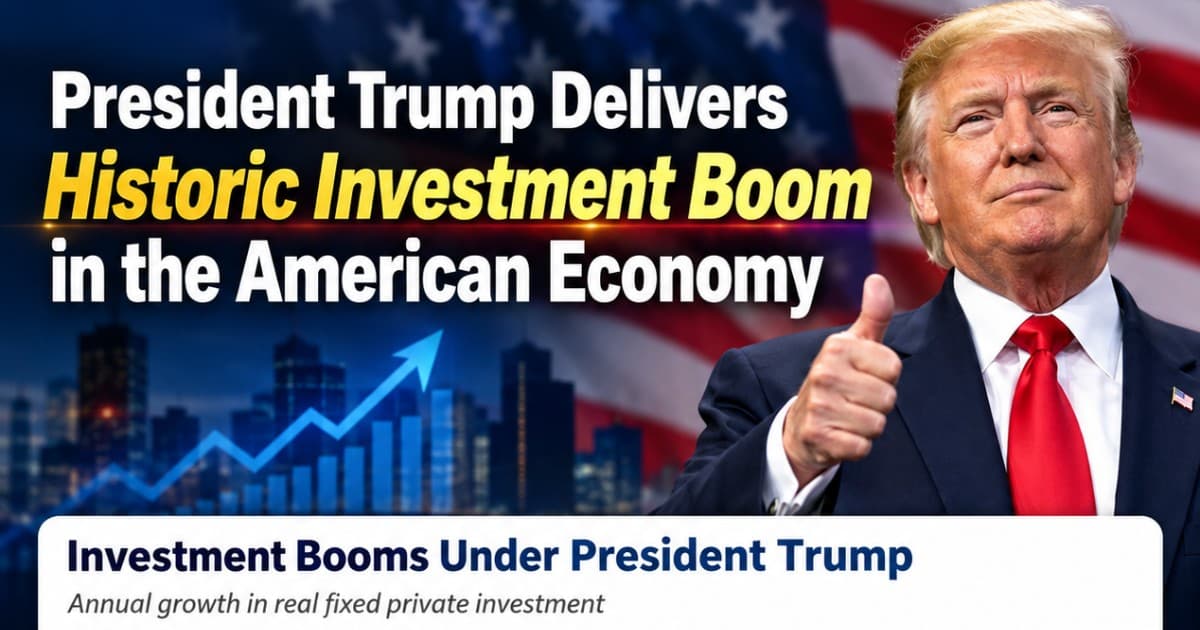
Breaking News
The Great American Investment Boom: Trillions in U.S. Manufacturing, Technology and Infrastructure
By The Daily Ledger3 min read10 views
The Trump administration says its America First economic policies have helped attract trillions of dollars in announced investments across U.S. manufacturing, technology, energy and infrastructure. Major commitments include large-scale semiconductor projects, AI infrastructure and industrial facilities. Independent economic data also show strong business investment, although the extent to which individual policies caused these investments remains a matter of economic analysis.
The Great American Investment Boom: Trillions in U.S. Manufacturing, Technology and Infrastructure Commitments
The United States is experiencing a major wave of announced investment across manufacturing, technology, artificial intelligence, semiconductors, energy and infrastructure.
The Trump administration has promoted the investment surge as evidence that its America First economic policies are encouraging companies to expand production and build more of their operations in the United States.
Trillions of Dollars in Announced Investment
The White House has compiled a list of major private-sector investment announcements made during President Trump's second term.
Among the largest commitments are investments from Apple, Meta, NVIDIA, Micron and other major companies.
The White House says these projects collectively represent trillions of dollars in planned investment in U.S. manufacturing, technology, AI and infrastructure.
These figures should be understood as announced commitments rather than money already spent. Many projects are scheduled to unfold over several years.
Semiconductor Manufacturing Expands
One of the largest examples is Taiwan Semiconductor Manufacturing Co. (TSMC).
In July, the U.S. government announced that TSMC had increased its planned U.S. investment to $265 billion.
The expansion includes additional advanced semiconductor fabrication and packaging facilities in Arizona.
The projects are intended to increase domestic production of advanced chips and strengthen the U.S. semiconductor supply chain.
Artificial Intelligence Drives New Construction
Artificial intelligence is another major source of investment.
Technology companies are building large data centers and computing facilities across the country to support growing demand for AI.
Major companies have announced investments worth hundreds of billions of dollars in AI infrastructure.
The expansion is also creating demand for construction, electricity generation, transmission infrastructure, computer equipment and semiconductor manufacturing.
Manufacturing Projects Across America
Investment is not limited to technology.
A $15 billion steel project announced in Iowa is expected to produce millions of tons of steel annually once fully operational.
The project is expected to create at least 1,750 permanent jobs and support thousands of construction positions.
Other investments are targeting critical minerals, advanced manufacturing, pharmaceuticals and other strategic industries.
Infrastructure Must Keep Up
The rapid growth of data centers and industrial facilities is also increasing demand for electricity and transmission capacity.
The Energy Department recently announced $2 billion in funding for grid modernization projects across 26 states.
The projects are expected to improve more than 21,000 miles of transmission lines and add more than 23 gigawatts of electricity capacity.
Business Investment Is Increasing
Government economic data also show strong business investment.
The Treasury Department reported that business investment in equipment and intellectual property increased at an annual rate of nearly 10% during the first half of 2026.
That investment includes spending on equipment, technology and other productive assets.
What Is Driving the Boom?
The administration attributes the investment surge to policies including tariffs, reshoring incentives, tax treatment for equipment and research, deregulation and efforts to strengthen domestic supply chains.
Companies, however, make investment decisions based on many factors.
Consumer demand, interest rates, energy availability, labor costs, technological changes, global competition and expected future profits can all influence where businesses choose to build.
As a result, determining how much of the investment surge is directly attributable to any single government policy requires additional economic analysis.
A Long-Term Test
The headline investment commitments are substantial, but their eventual economic impact will depend on execution.
Projects must move from announcements to construction and ultimately into production.
The effects on employment, wages, productivity, manufacturing capacity and regional economies will become clearer as these investments are completed.
Conclusion
The United States is seeing a significant wave of investment announcements spanning semiconductors, artificial intelligence, manufacturing, energy and infrastructure.
The Trump administration presents the trend as evidence that its America First economic strategy is attracting capital and encouraging companies to build in the United States.
At the same time, many of the announced projects extend years into the future, making actual construction, spending and production important measures to watch.
The next phase of the investment boom will be determined by how many announced projects become operating American facilities—and what economic benefits they ultimately generate.
#AmericanInvestment #USManufacturing #Trump #AmericaFirst #Technology #AI #Semiconductors #Infrastructure #USEconomy #BusinessNews

Comments (0)
No comments yet. Be the first to share your thoughts.
Leave a comment
Comments are reviewed before they appear.