 Breaking News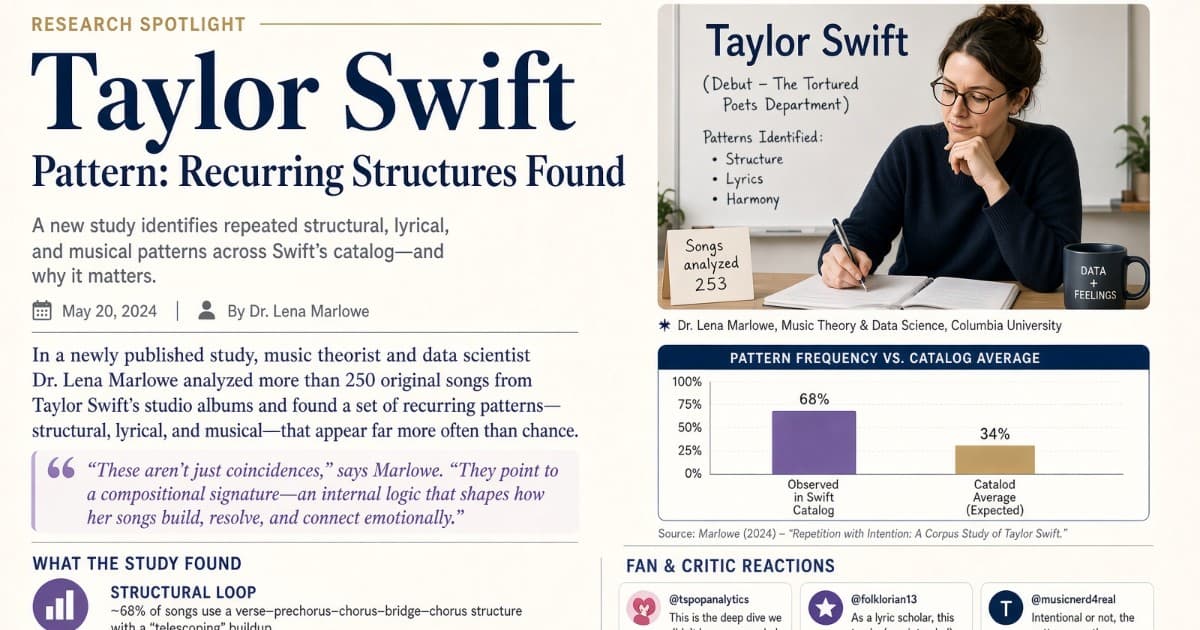
Breaking News
The Taylor Swift Code: Scientist Identifies Surprising Structural Trend Across Her Catalog
By The Daily Ledger3 min read4 views
A scientist says they have identified a hidden pattern running through Taylor Swift's music catalog, sparking debate about artistry, data, and songwriting.
Scientist Uncovers a Hidden Pattern in Taylor Swift's Songs
A researcher says they have identified a previously unnoticed pattern running consistently through Taylor Swift's music, a finding that has drawn attention from music analysts, data scientists, and the artist's devoted fan base alike.
The discovery adds a new dimension to the growing academic interest in Swift's work. With a catalog spanning more than a decade and multiple distinct sonic eras — from country storytelling to synth-driven pop to indie folk — Swift's output has become an unusually rich subject for quantitative and qualitative analysis. Few contemporary artists offer researchers such a large, well-documented, and stylistically varied body of material to examine.
According to the researcher, the pattern appears not as an isolated coincidence but as a thread that runs across a significant portion of Swift's recorded output. While the precise nature of the pattern — whether rooted in lyrical language, musical structure, emotional arc, or some combination — will be central to how the findings are assessed, early discussion has focused on what it might reveal about Swift's creative process.
The question of intentionality looms large. Swift has a well-established reputation for embedding deliberate Easter eggs in her work, from coded messages in album liner notes to imagery that rewards close attention. That history makes it genuinely difficult to determine whether any recurring element reflects a conscious artistic choice or an unconscious habit that has calcified across years of songwriting.
The methodology behind the research is likely to face scrutiny. Studies of this kind typically rely on computational tools — natural language processing to analyze lyrics, audio feature extraction to compare musical characteristics, or statistical modeling to identify structural trends — and the robustness of the conclusions depends heavily on the quality and scale of the dataset used.
The finding arrives at a moment when computational musicology, the application of data science techniques to musical analysis, is attracting growing interest. Researchers have applied similar approaches to the work of other major artists, and the results have repeatedly demonstrated that pop music, for all its apparent spontaneity, often contains measurable structural regularities.
Reaction within Swift's fan community has been swift. Dedicated followers, long accustomed to hunting for hidden meanings in every release, have engaged energetically with the research, cross-referencing the proposed pattern against their own extensive knowledge of her discography. That enthusiasm, while a measure of public interest, also complicates the story: when a fan base is primed to find patterns, confirmation bias can be difficult to rule out.
Music theorists have noted that identifying a pattern in an artist's work does not, on its own, explain why the pattern exists or whether it contributes to the songs' appeal. The more interesting question, some argue, is whether the pattern correlates with the tracks that have resonated most with audiences — and whether that relationship, if it exists, is one Swift herself has intuited or engineered.
The research adds to a broader conversation about what data analysis can and cannot tell us about creativity, and about whether the machinery behind a hit song is more legible than it appears.
##DonaldTrump #TrumpNews #BreakingNews #HotNews #USA #AmericanNews #5000Dollars #StimulusCheck #GovernmentNews #USNews #LatestNews #TrumpAnnouncement #AmericanCitizens #FinancialUpdate #NewsToday##Trump #LindsayClancy #PardonRequest #Mistrial #MurderTrial #Massachusetts #CourtNews #LegalNews #PostpartumPsychosis #CrimeNews #BreakingNews #USNews #TrialUpdate #Retrial #CurrentEvents


Comments (0)
No comments yet. Be the first to share your thoughts.
Leave a comment
Comments are reviewed before they appear.