 Breaking News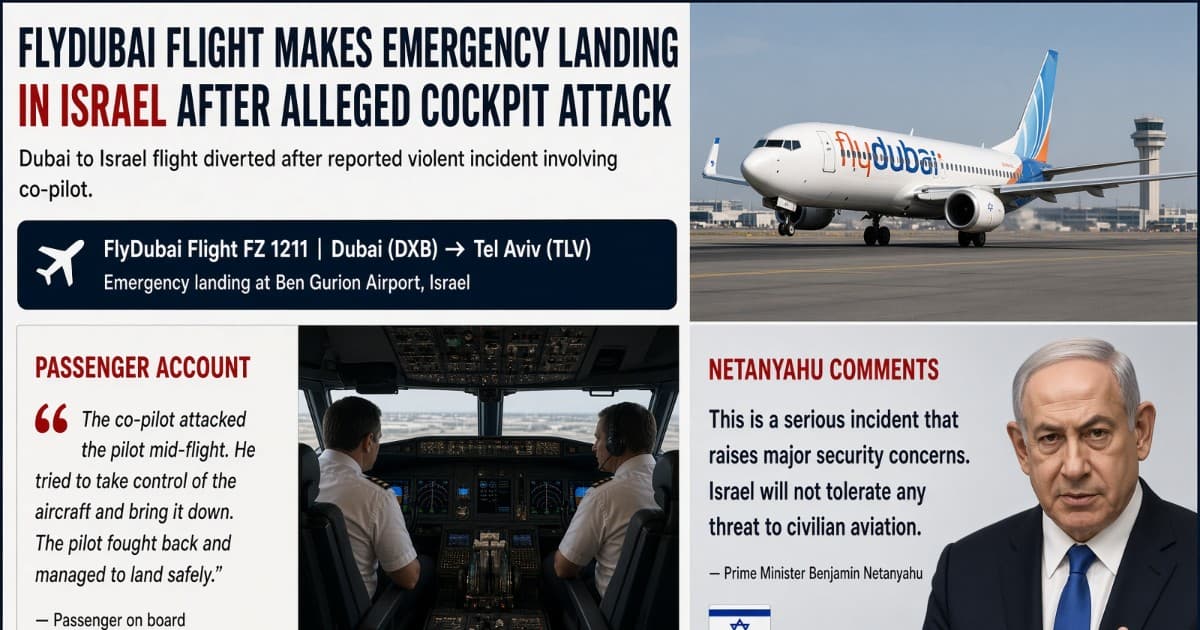
Breaking News
FlyDubai Co-Pilot Allegedly Attacks Pilot Mid-Flight in Attempt to Down Plane, Netanyahu Responds
By The Daily Ledger2 min read3 views
A FlyDubai flight from Dubai to Israel made an emergency landing after a co-pilot allegedly stabbed and attacked the captain in an apparent attempt to crash…
FlyDubai Co-Pilot Allegedly Attacks Pilot in Attempt to Crash Israel-Bound Flight
A FlyDubai passenger jet traveling from Dubai to Israel made an emergency landing after an alleged violent altercation inside the cockpit, in which the co-pilot reportedly attacked the captain and attempted to bring down the aircraft. The incident, which drew immediate comment from Israeli Prime Minister Benjamin Netanyahu, has prompted urgent questions about aviation security on one of the region's most politically sensitive air corridors.
Passengers aboard the flight described a harrowing experience as the crew struggled to manage what one traveler characterized as an attempt by the co-pilot to murder the pilot and crash the plane. While accounts from inside the cabin were limited — the reinforced cockpit door separating crew from passengers means few could witness events directly — the aircraft's sudden diversion and the visible distress of cabin crew signaled that something was seriously wrong.
The plane landed safely at an alternate airport, where emergency services and law enforcement were waiting. The captain was reported to have been injured during the attack. The co-pilot was taken into custody following the landing, and passengers were evacuated from the aircraft.
Israeli Prime Minister Netanyahu addressed the incident publicly, indicating that Israeli authorities were following the situation closely. His involvement underscores the heightened sensitivity of the Dubai-to-Israel route, which only became possible following the 2020 Abraham Accords that normalized diplomatic relations between the United Arab Emirates and Israel. FlyDubai has operated services on the route since that normalization agreement came into effect.
The alleged attack draws inevitable comparisons to the 2015 Germanwings disaster, in which a co-pilot deliberately crashed an Airbus A320 into the French Alps, killing all 150 people on board. That tragedy prompted aviation regulators across Europe and beyond to introduce requirements that two crew members must be present in the cockpit at all times. Whether similar safeguards were in place on this flight, and whether they played any role in allowing the attack to be stopped, will likely be a focus of the investigation.
FlyDubai, a government-linked low-cost carrier based in Dubai, had not issued a detailed public statement on the specifics of the cockpit incident at the time of reporting. UAE and Israeli aviation and law enforcement authorities are expected to conduct a joint or parallel investigation into the circumstances of the attack, including the co-pilot's background, any possible motive, and whether warning signs were missed during the crew member's vetting or recent conduct.
The motive for the alleged attack remains unclear. Investigators will examine whether the incident was driven by ideology, a mental health crisis, or other factors. For now, aviation security experts say the case is a stark reminder that the greatest vulnerability to an aircraft can, in rare but catastrophic instances, come from within the cockpit itself.
##DonaldTrump #TrumpNews #BreakingNews #HotNews #USA #AmericanNews #5000Dollars #StimulusCheck #GovernmentNews #USNews #LatestNews #TrumpAnnouncement #AmericanCitizens #FinancialUpdate #NewsToday


Comments (0)
No comments yet. Be the first to share your thoughts.
Leave a comment
Comments are reviewed before they appear.