 World
World
World
Trump Pauses New Tariffs on Canada, Says Countries Are Close to a Trade Deal
By The Daily Ledger12 min read124 views
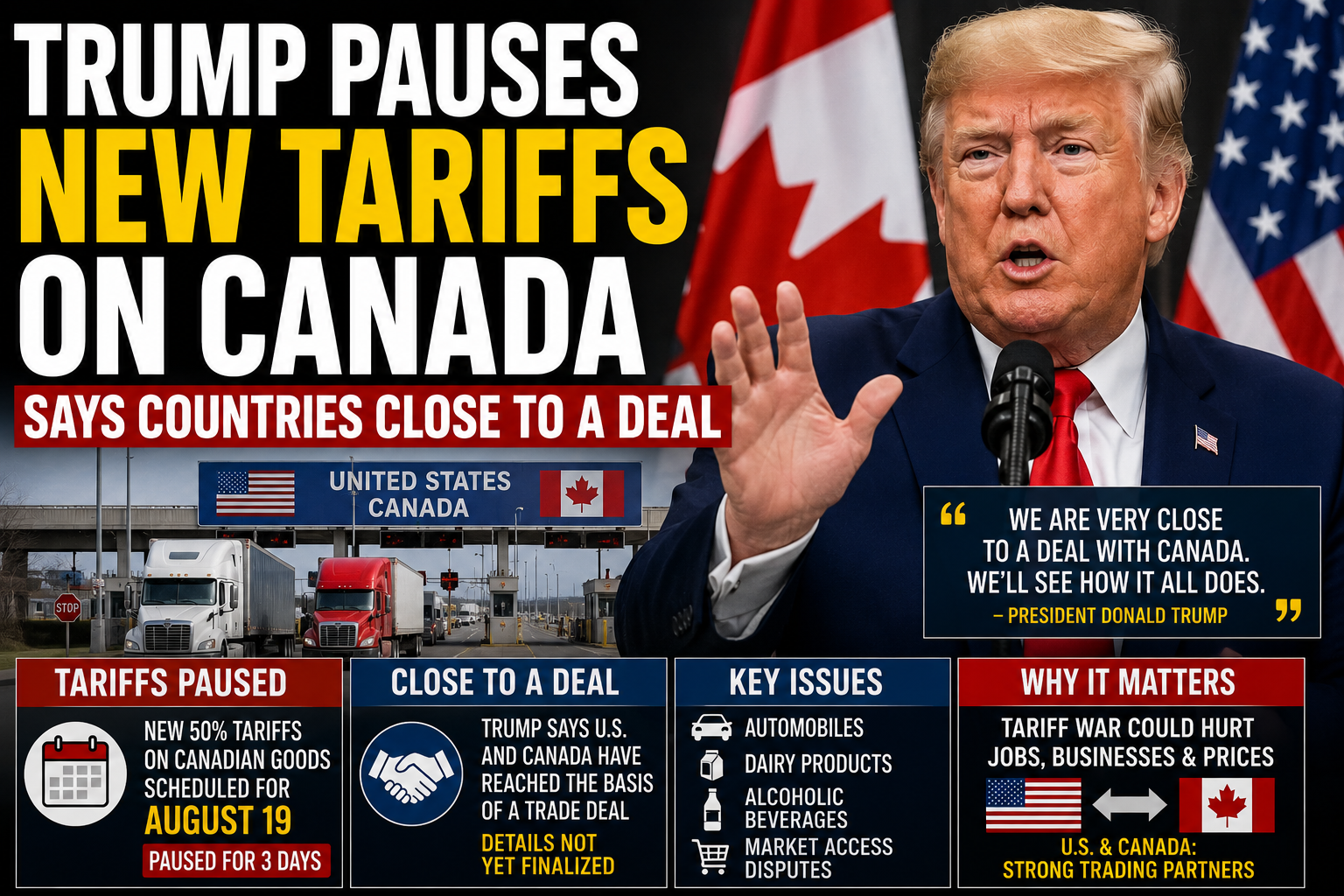
President Donald Trump has delayed new 50% tariffs on billions of dollars of Canadian goods for three days as Washington and Ottawa work to finalize a last-minute trade agreement. The move provides temporary relief from an escalating U.S.-Canada trade fight, but major disputes over autos, dairy, alcohol and other market-access issues remain.
Trump Pauses New Tariffs on Canada, Says Countries Are Close to a Trade Deal
President Donald Trump has temporarily halted a new round of 50% tariffs on Canadian goods after announcing that the United States and Canada are close to finalizing a trade agreement.
The dramatic last-minute decision came just before the tariffs were scheduled to take effect on August 19.
Trump said the additional duties would be postponed for three days while officials complete the documentation necessary to finalize an agreement between Washington and Ottawa.
The development represents a potentially significant de-escalation in one of the most consequential trade disputes of Trump's second term.
But the trade war is not necessarily over.
The pause is temporary, important details of the emerging agreement have not been publicly released, and several major disputes between the two countries remain unresolved.
Trump Delays 50% Tariffs
The threatened tariffs were substantial.
Trump had ordered additional duties of 50% on a wide range of Canadian products after accusing Canada of discriminating against American businesses and exports.
The measures were expected to affect approximately $20 billion worth of Canadian goods.
Products potentially affected included goods from industries ranging from dairy and alcoholic beverages to manufacturing, building materials and sporting equipment.
The duties were scheduled to begin at 12:01 a.m. Eastern time on August 19.
Instead, Trump announced that he would hold them back for three days.
That gives negotiators a narrow window to convert their political understanding into a finalized agreement.
Trump Says There Is a Deal
Trump portrayed the development positively, saying the two countries had reached an agreement that now needed to be finalized.
That is an important distinction.
Washington and Ottawa appear to have reached enough of an understanding to prevent the tariffs from immediately taking effect.
But the complete agreement has not yet been publicly presented.
That means the exact concessions made by Canada — and what the United States has promised in return — remain unclear.
Until the documents are completed and released, the possibility of another breakdown cannot be eliminated.
Carney and Trump Hold Direct Talks
Canadian Prime Minister Mark Carney has been directly involved in the effort to prevent the tariffs.
Carney and Trump held discussions as the deadline approached, while trade officials from both countries worked intensively behind the scenes.
For Canada, avoiding another major tariff escalation has become an economic priority.
The United States is Canada's largest trading partner.
Hundreds of billions of dollars in goods and services cross the border every year.
Canadian industries including automobiles, metals, forestry, agriculture and manufacturing are deeply integrated with the American economy.
A prolonged trade war therefore creates substantial risks for both countries.
Why Trump Threatened Canada
The latest dispute involves several longstanding American complaints about Canadian trade policy.
The Trump administration argues that Canada discriminates against U.S. products in important sectors.
One major issue is dairy.
Washington has repeatedly criticized Canada's supply-management system and restrictions affecting American dairy producers.
Alcohol has become another major source of tension.
Some Canadian provinces removed or restricted American alcoholic beverages as relations between the countries deteriorated.
The Trump administration argues that those measures unfairly discriminate against American producers.
Automobiles represent another important dispute.
Trump has accused Canada of maintaining policies that disadvantage U.S. vehicle exports.
Those complaints formed the basis of the administration's latest tariff campaign.
Trump Uses an Old Trade Law
The legal mechanism behind the tariffs is particularly notable.
Trump invoked Section 338 of the Tariff Act of 1930.
The law gives a president authority, under certain circumstances, to impose additional duties of as much as 50% when another country is determined to discriminate against American commerce.
It is an unusually old and rarely used provision.
The administration turned to Section 338 after Trump's broader tariff program encountered significant legal challenges.
The White House issued proclamations in July accusing Canada of discriminatory practices involving vehicles, dairy products and alcoholic beverages.
Those proclamations established the August 19 deadline.
The Supreme Court Changed Trump's Tariff Strategy
Trump's second-term tariff agenda has faced major legal complications.
Earlier tariff measures relied heavily on emergency presidential powers.
But a Supreme Court ruling undermined important portions of that strategy.
The administration subsequently searched for other legal mechanisms that could support its aggressive trade agenda.
Section 338 became one of those tools.
Its use against Canada represents an important test of how far the administration can push presidential tariff authority under older trade statutes.
Legal challenges remain possible.
Canada Prepared to Fight Back
Ottawa had been preparing for the possibility that negotiations would fail.
Canadian officials indicated that the government had contingency plans ready if the 50% tariffs took effect.
Canada has previously retaliated against American tariffs.
That raised the possibility of another cycle of escalating duties in which Washington imposed tariffs, Ottawa responded with countermeasures and Trump answered with additional restrictions.
Businesses on both sides of the border warned that such escalation could become increasingly expensive.
The three-day pause temporarily reduces that danger.
A $20 Billion Tariff Threat
Although U.S.-Canada trade is enormous, the newest tariff package targeted a relatively limited portion of total Canadian exports.
Approximately $20 billion worth of goods were expected to be affected.
That represents only a fraction of Canada's total exports to the United States.
But the consequences would not have been evenly distributed.
For companies selling products specifically included on the tariff lists, a 50% additional duty could be devastating.
Smaller manufacturers and exporters would have had particular difficulty absorbing the cost.
Some businesses could have raised prices.
Others could have reduced exports to the United States.
Some might have cut production or employment.
Consumers Could Feel the Effects
Tariffs are collected from importers when products enter the United States.
Those companies then decide how much of the additional cost they can absorb and how much must be passed to customers.
That means American consumers can ultimately pay part of the price.
A 50% tariff is particularly large.
If applied broadly enough, such duties can increase prices for imported goods and for American products that depend on Canadian materials.
Canada and the United States have unusually integrated supply chains.
A component can cross the border several times before becoming part of a finished product.
Tariffs can therefore create costs at multiple points in the production process.
Autos Remain a Major Problem
The automobile industry is particularly vulnerable to U.S.-Canada trade disputes.
American and Canadian vehicle production has been integrated for decades.
Parts produced in one country are routinely shipped to factories in the other.
A vehicle assembled in the United States may contain Canadian components.
A Canadian-built vehicle may contain substantial American content.
That makes tariffs especially disruptive.
Rather than simply hurting a foreign competitor, they can raise costs for manufacturers operating on both sides of the border.
Auto policy therefore remains one of the most difficult issues in the broader negotiations.
Dairy Is Another Flashpoint
Canada's dairy system has frustrated American policymakers for years.
Canada operates a supply-management system intended to stabilize domestic production and prices.
The United States argues that elements of the system restrict American producers' ability to compete fairly in the Canadian market.
Trump has repeatedly highlighted the issue.
His administration argues that American farmers deserve greater access to Canadian consumers.
Canada, however, considers supply management politically sensitive and important to domestic agricultural communities.
Any major Canadian concession on dairy could therefore generate political opposition inside Canada.
The Alcohol Fight
Alcohol has become one of the more unusual fronts in the trade dispute.
Following earlier American tariffs, Canadian provinces took measures against U.S. alcoholic beverages.
American wine and spirits disappeared from some Canadian shelves.
Washington says those actions discriminate against U.S. producers.
The Trump administration has pushed Canada to restore access for American products.
But alcohol distribution is heavily influenced by provincial governments rather than controlled entirely by Ottawa.
That complicates Carney's ability to deliver a national solution.
Could Keystone XL Return?
Another intriguing possibility surrounding the negotiations is the Keystone XL pipeline.
Trump has suggested that reviving the controversial project could form part of a broader economic understanding with Canada.
The pipeline was designed to transport Canadian crude oil to the United States.
Its presidential permit was revoked under President Joe Biden.
Trump has long supported the project and argued that greater North American energy production would improve U.S. energy security.
Whether Keystone XL will actually become part of the final trade arrangement remains uncertain.
No completed agreement has yet established its revival.
Markets Get Temporary Relief
The tariff pause removes an immediate source of uncertainty for investors and businesses.
Before the announcement, markets had been watching the approaching deadline closely.
The Canadian dollar weakened slightly Tuesday as investors waited to see whether Carney could secure a last-minute agreement.
A finalized deal could reduce some of the economic uncertainty surrounding North American trade.
But markets will want details.
A three-day delay alone does not resolve the underlying disputes.
USMCA Looms Over Everything
The fight also comes against the backdrop of broader negotiations over the U.S.-Mexico-Canada Agreement.
USMCA replaced the North American Free Trade Agreement during Trump's first presidency.
The agreement governs one of the world's largest trading relationships.
But Trump has increasingly demanded changes to trade arrangements he believes disadvantage American companies and workers.
Canada wants predictable access to the U.S. market.
Washington wants additional concessions.
Those competing priorities mean the latest tariff dispute could ultimately become part of a much larger renegotiation of North American trade rules.
Why Canada Matters So Much to the U.S.
Canada is not a minor trading partner.
It is one of America's largest economic partners and one of its closest allies.
The two countries exchange enormous quantities of energy, vehicles, machinery, agricultural goods and services.
Millions of American jobs are connected directly or indirectly to that trade.
Canada is also an important supplier of oil, electricity, minerals and other strategic resources.
That makes an extended U.S.-Canada trade war fundamentally different from a dispute involving a country with limited economic ties to the United States.
Damage can move rapidly in both directions.
Trump's Tariff Strategy
The confrontation reflects Trump's broader philosophy of trade.
Trump views tariffs not simply as taxes on imports but as negotiating leverage.
His strategy generally follows a recognizable pattern.
Threaten substantial tariffs.
Establish a deadline.
Demand concessions.
Negotiate under pressure.
Then either impose the duties or postpone them if the other government moves toward an agreement.
The Canada dispute is a textbook example.
A 50% tariff threat created enormous pressure.
With only hours remaining before implementation, negotiations intensified.
Trump then paused the tariffs after saying progress had produced a deal.
Supporters Say the Strategy Works
Trump's supporters will likely point to the Canadian negotiations as evidence that tariff threats produce results.
Their argument is straightforward.
Without the threat of a 50% tariff, Canada would have had less incentive to make concessions.
By demonstrating a willingness to impose severe economic consequences, Trump increased American negotiating leverage.
If the final agreement expands market access for U.S. farmers, manufacturers and other businesses, the White House will portray the outcome as validation of that strategy.
Critics See Economic Uncertainty
Critics make the opposite argument.
They say repeatedly threatening enormous tariffs creates unnecessary uncertainty for businesses.
Companies making investment decisions need to know what their costs will be months or years from now.
A tariff scheduled for Wednesday and postponed Tuesday night makes planning difficult.
Businesses may delay hiring.
They may postpone investment.
They may increase inventories as protection against future tariff threats.
Critics argue that those behaviors can slow economic growth even when the threatened tariffs never ultimately take effect.
The Three-Day Deadline Matters
The most important immediate detail is the length of the pause.
Three days is not much time.
It suggests Washington believes negotiators are close enough that the remaining issues can be resolved quickly.
But it also preserves pressure on Canada.
Trump has not withdrawn the tariff threat permanently.
If negotiations collapse, the administration could allow the duties to take effect after the postponement.
That makes the next several days crucial.
What We Still Don't Know
Several important questions remain unanswered.
Exactly what has Canada agreed to?
Will American alcohol return to Canadian provincial stores?
Will Canada make additional concessions involving dairy?
How will automobile trade be handled?
Will existing American tariffs on Canadian steel, aluminum or other products be reduced?
Will Keystone XL become part of the agreement?
And how will the deal interact with the broader USMCA negotiations?
Until the final documents are released, those questions remain open.
A Deal Would Mark a Major De-Escalation
If the two governments successfully finalize the agreement, it could mark one of the most significant improvements in U.S.-Canada relations in months.
The countries have endured repeated disputes over tariffs and retaliation.
Business groups have warned about deteriorating confidence.
Canadian public opinion toward the United States has also been strained.
A comprehensive agreement would not necessarily eliminate every dispute.
But it could prevent another major escalation and restore some predictability to North American commerce.
Failure Could Restart the Trade War
The opposite scenario remains possible.
If negotiations break down during the three-day window, the 50% tariffs could return.
Canada could then retaliate.
Trump could respond again.
That cycle would put renewed pressure on manufacturers, farmers, exporters and consumers.
The temporary pause therefore represents an opportunity rather than a completed resolution.
Bottom Line
President Donald Trump has postponed new 50% tariffs on approximately $20 billion worth of Canadian goods after saying the United States and Canada have reached the basis of a trade agreement.
The duties had been scheduled to take effect on August 19.
They are now delayed for three days while officials finalize the agreement.
Canadian Prime Minister Mark Carney and Trump have been directly involved in the negotiations, which address longstanding disputes involving automobiles, dairy, alcohol and broader market access.
For businesses and consumers on both sides of the border, the pause provides immediate relief.
But it should not yet be confused with the end of the trade dispute.
The full agreement has not been publicly released.
Important details remain unresolved.
And Trump's 50% tariff threat has been postponed — not necessarily eliminated.
The next three days will determine whether the latest confrontation becomes another chapter in the U.S.-Canada trade war or the beginning of a significant new trade agreement.
#Climate
Comments (0)
No comments yet. Be the first to share your thoughts.
Leave a comment
Comments are reviewed before they appear.