 World
World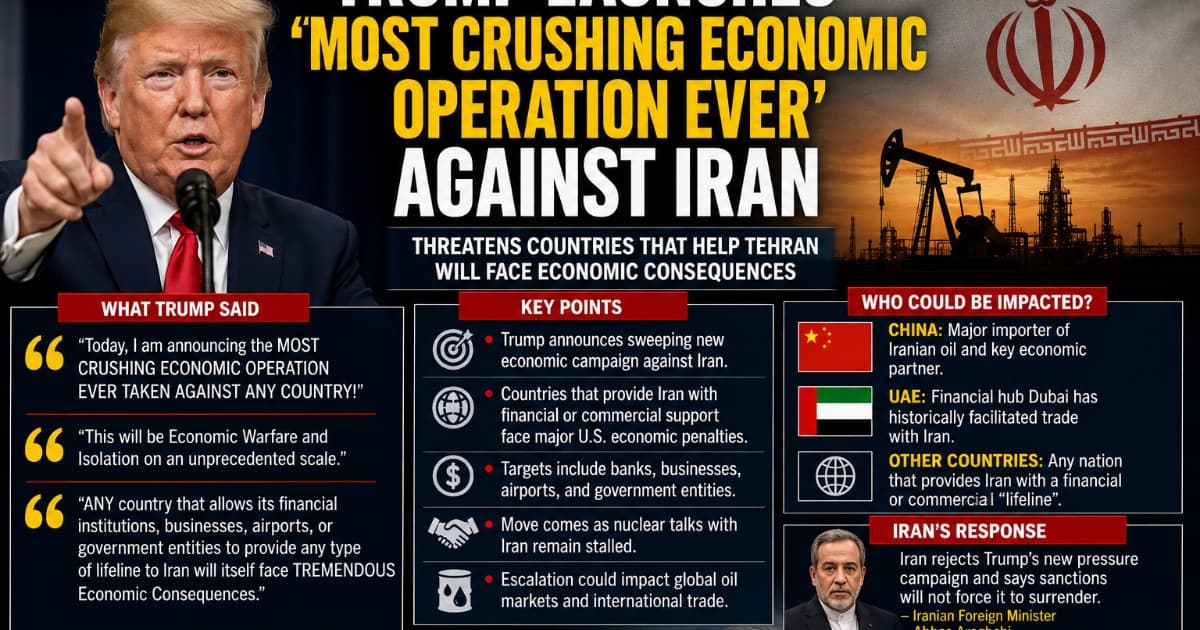
World
Trump Declares ‘Economic Warfare’ on Iran, Threatens Countries That Provide Tehran a Lifeline
By The Daily Ledger10 min read158 views
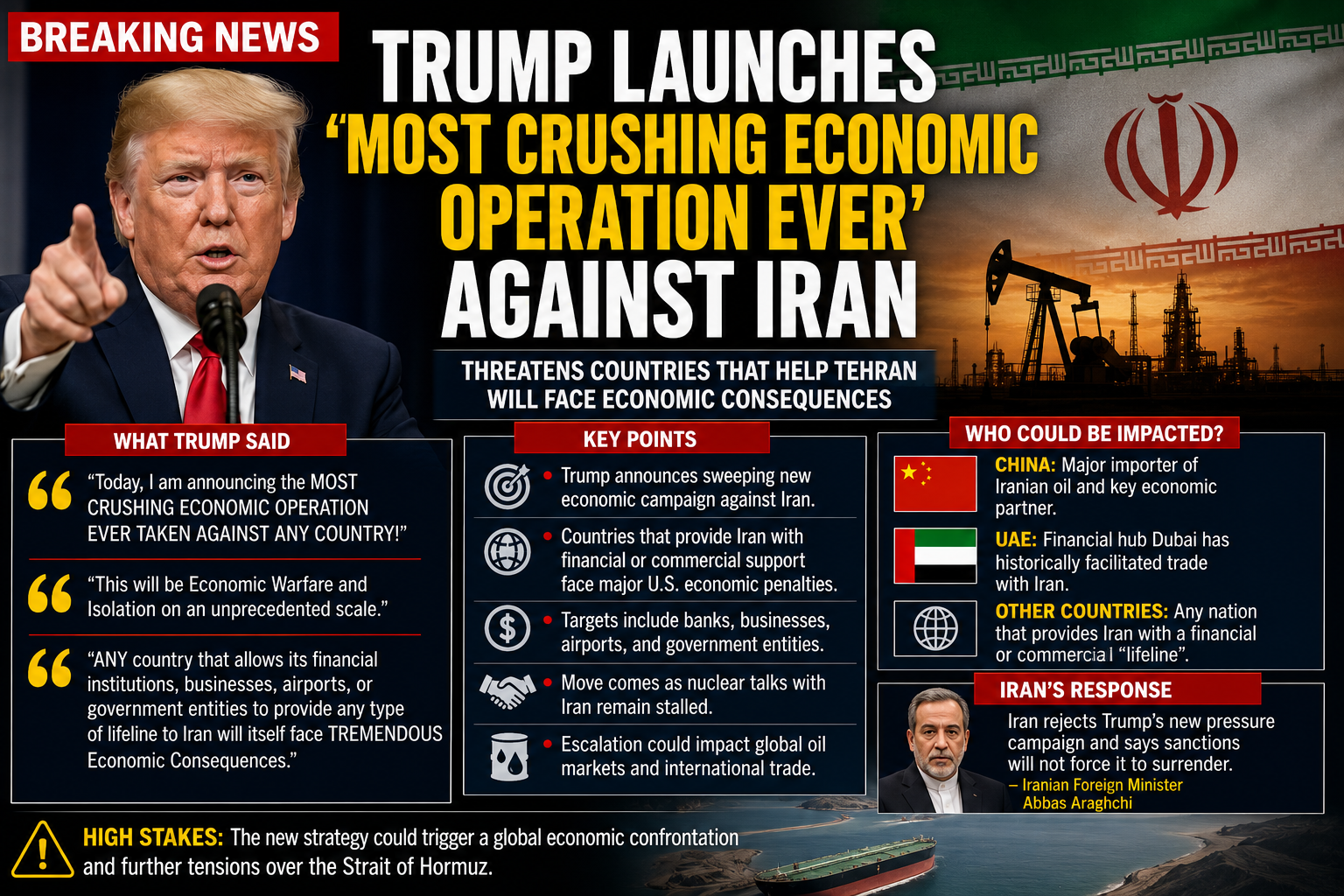
President Donald Trump has announced what he calls the “most crushing economic operation ever taken against any country,” promising unprecedented economic isolation of Iran and warning that countries whose banks, businesses, airports or government entities provide Tehran with a lifeline could face severe U.S. economic consequences. Iran has dismissed the threat, while China is urging diplomacy instead of escalating pressure.
Trump Declares ‘Economic Warfare’ on Iran, Threatens Countries That Provide Tehran a Lifeline
President Donald Trump has announced a dramatic escalation of economic pressure against Iran, declaring what he describes as the most severe economic campaign ever directed against another country.
The new strategy goes beyond targeting Iran itself.
Trump is also threatening potentially severe economic punishment against foreign countries whose banks, companies, airports or government institutions provide Tehran with financial or commercial assistance.
The announcement represents a significant expansion of Washington’s attempt to isolate Iran as the nearly six-month conflict involving the United States, Israel and Iran continues without a comprehensive settlement.
“Today, I am announcing the MOST CRUSHING ECONOMIC OPERATION EVER TAKEN AGAINST ANY COUNTRY!” Trump wrote on Truth Social.
He described the strategy as “Economic Warfare and Isolation on an unprecedented scale.”
Trump then delivered a warning to governments around the world.
He said any country allowing its financial institutions, businesses, airports or government entities to provide Iran with what he described as a lifeline would face major economic consequences from the United States.
The president did not specify exactly what those penalties would be.
That unanswered question could now become one of the most important issues facing governments and companies that continue doing business with Iran.
Pressure Expands Beyond Iran
The most consequential element of Trump's announcement may not be additional sanctions against Iran itself.
Iran has already lived under extensive American sanctions for decades.
Instead, Trump's threat appears designed to make other countries choose between maintaining economic relationships with Iran and preserving access to the much larger U.S. financial and commercial system.
This type of strategy can dramatically increase the reach of American sanctions.
A foreign bank, for example, may have relatively little direct business with the United States but still depend on access to dollar-denominated transactions.
A company may purchase Iranian products while simultaneously relying on American customers, suppliers or technology.
Governments could therefore face enormous pressure to distance themselves from Tehran.
Trump Does Not Specify the Punishment
Despite the dramatic language, Trump has not yet publicly detailed exactly what “tremendous economic consequences” will mean for countries that continue supporting Iran.
Potential tools available to Washington could include sanctions, restrictions on financial transactions, limits on access to the U.S. market or penalties targeting specific companies and financial institutions.
But those possibilities should not be confused with measures that have already been formally announced.
The precise enforcement mechanism remains an important unanswered question.
The administration is expected to provide additional details as the campaign develops.
China Could Become the Biggest Test
China immediately becomes one of the most important countries to watch.
Beijing remains Iran's largest oil customer and one of Tehran's most important economic partners.
That relationship creates a difficult strategic question for Trump.
Applying the new campaign aggressively against Chinese companies or financial institutions could significantly increase pressure on Iran.
But it could also trigger a major confrontation between Washington and Beijing.
China responded to Trump's announcement by arguing that sanctions and pressure will not resolve the conflict and calling instead for diplomatic solutions.
The Chinese response signals that Beijing may resist Washington's effort to economically isolate Tehran.
That could make China the biggest test of whether Trump's new strategy can actually achieve the global isolation he is seeking.
Iran Rejects Trump’s Threat
Iran has responded defiantly.
Iranian Foreign Minister Abbas Araghchi dismissed Trump's announcement as a continuation of what Tehran considers failed American policies.
Iranian officials have characterized Washington's escalating economic pressure as economic terrorism and argued that additional sanctions will not force the country to surrender.
Tehran has spent decades developing methods to survive international sanctions.
Those methods include alternative financial networks, intermediaries, oil-trading arrangements and deeper economic relationships with countries outside the Western sanctions system.
Trump's strategy will therefore depend heavily on whether Washington can disrupt those networks.
Why Trump Is Turning Back to Economic Pressure
The announcement comes at a difficult moment in Trump's Iran strategy.
The war has continued for nearly six months.
American and Israeli military operations have inflicted major damage on Iranian military and nuclear infrastructure.
But the conflict has not produced the comprehensive political agreement Washington wants.
Diplomatic efforts have repeatedly stalled.
Trump recently said there were no negotiations taking place with Iran and none scheduled.
That leaves economic pressure as one of Washington's primary remaining tools for attempting to force Tehran back toward negotiations.
Treasury Secretary Scott Bessent had already signaled that the administration was preparing economic measures against Iran unlike anything previously attempted.
Trump's latest announcement appears to mark the political launch of that campaign.
Strait of Hormuz Remains Central
The economic confrontation cannot be separated from the continuing crisis in the Strait of Hormuz.
The strategic waterway is one of the world's most important energy corridors.
Trump says U.S. operations have removed Iranian mines and declared the strait open.
But commercial shipping remains heavily disrupted.
Iran continues to insist that restrictions will remain until Washington meets its conditions.
Those conditions include sanctions relief, access to frozen Iranian assets and changes to American military pressure.
Washington has rejected those demands.
The result is a stalemate.
Iran possesses leverage over a critical global energy route.
The United States possesses extraordinary financial and economic leverage over countries that interact with the American economy.
Trump is now signaling that he intends to use that leverage aggressively.
The Naval Blockade Adds Another Layer
The United States is also maintaining a naval blockade targeting Iran.
American officials have said the blockade can remain in place indefinitely.
That means Tehran is being pressured simultaneously through military, maritime and financial channels.
The strategy appears designed to make Iran's economic situation increasingly difficult over time.
Washington hopes that eventually the cost becomes high enough that Tehran accepts American negotiating demands.
Iran, however, has shown no indication that it is prepared to capitulate immediately.
What Washington Wants
Trump's ultimate objectives extend beyond simply damaging Iran's economy.
The administration wants a more restrictive agreement governing Iran's nuclear program.
Washington also wants control over Iran's highly enriched uranium stockpile and stronger limits on Tehran's nuclear capabilities.
Trump withdrew the United States from the 2015 Iran nuclear agreement during his first presidency.
His administration now wants a substantially tougher arrangement.
Iran maintains that its nuclear program has peaceful purposes and argues that Washington's demands violate its sovereign rights.
That fundamental disagreement remains unresolved.
The UAE Has Already Moved Against Iran
There are signs that American pressure is already influencing some regional governments.
The United Arab Emirates has suspended significant trade activity involving Iran following regional security tensions and allegations involving Iranian missile activity.
That is particularly significant because the UAE has historically served as an important commercial connection for Iranian businesses.
If other governments follow, Iran could become increasingly economically isolated.
But persuading major countries such as China to participate will be considerably more difficult.
Secondary Sanctions Could Have Global Consequences
The biggest economic question now concerns how aggressively Washington applies pressure to third countries.
If Trump's warning remains largely rhetorical, its effect may be limited.
If the administration begins imposing severe penalties on major foreign banks, corporations or governments that maintain relationships with Iran, the consequences could spread throughout the global economy.
Companies could be forced to choose between Iran and the United States.
Banks could become reluctant to process transactions involving Iranian entities.
Airlines and airports could reconsider connections.
Shipping companies could avoid Iranian commerce.
Insurance companies could refuse coverage.
The cumulative effect could make international business with Iran increasingly difficult.
Oil Markets Will Be Watching
Energy markets are particularly sensitive to the announcement.
Iran remains an important oil producer.
China purchases large quantities of Iranian crude.
If Trump's campaign successfully reduces Iranian oil exports, global supply could tighten.
At the same time, disruption in the Strait of Hormuz has already created substantial uncertainty surrounding energy shipments from the Persian Gulf.
That combination creates the possibility of additional upward pressure on oil prices.
Higher oil prices can eventually affect gasoline prices, transportation costs and inflation around the world.
That means Trump's economic war against Iran could produce consequences far beyond Tehran.
The Strategy Carries Risks for Washington
Economic warfare does not impose costs exclusively on its target.
An aggressive sanctions campaign could strain relations between Washington and governments that refuse to cooperate.
China represents the clearest example.
But other countries may also object to the United States attempting to dictate their commercial relationships.
Some governments could search for financial mechanisms that reduce their dependence on the U.S. dollar.
Others could increase cooperation with China or other powers.
Trump therefore faces a strategic balancing act.
The administration wants to make Iran's isolation as comprehensive as possible without creating an international coalition determined to circumvent American economic power.
Iran Has Survived Sanctions Before
Another challenge is Iran's long experience under sanctions.
The Islamic Republic has faced various forms of American economic pressure since 1979.
It has developed extensive systems for circumventing restrictions.
Oil can move through intermediaries.
Companies can operate through front organizations.
Transactions can be routed through alternative financial systems.
Ships can change ownership, registration or identification practices.
Washington has spent years attempting to disrupt these networks.
Trump's new campaign appears intended to attack them more aggressively.
Whether it succeeds will depend heavily on enforcement.
Economic Pressure Replaces Diplomatic Momentum
The timing of Trump's announcement is especially significant.
Only days ago, there remained hope that diplomacy might produce a broader agreement.
That optimism has faded.
Trump says no formal talks are currently scheduled.
Iran remains unwilling to accept Washington's conditions.
The United States remains unwilling to accept Tehran's.
Trump is therefore shifting the emphasis toward coercion.
Rather than offering Iran additional incentives, Washington is threatening to make the economic cost of continued resistance increasingly severe.
‘Economic Warfare’ Is an Unusually Direct Description
Presidents frequently announce sanctions.
They rarely describe them as economic warfare.
Trump's terminology appears intentional.
He wants both Iran and the rest of the world to understand that Washington views economic pressure as an active component of the broader conflict.
That language also raises the stakes.
If Trump promises the most crushing economic operation ever imposed on a country, his administration will face pressure to demonstrate measures substantially stronger than the sanctions already surrounding Iran.
The details that emerge next will therefore matter enormously.
What Happens Next?
Several developments should be watched closely.
First, the Treasury Department could announce specific new sanctions and enforcement measures.
Second, Washington could identify foreign banks, companies or governments it believes are providing Iran with economic support.
Third, China will have to decide how strongly it intends to resist American pressure.
Fourth, Iran could respond economically, militarily or through further restrictions around the Strait of Hormuz.
And finally, the new campaign could either push Tehran back toward negotiations or harden its refusal to compromise.
That last question will determine whether Trump's strategy produces diplomacy or another round of escalation.
Bottom Line
President Donald Trump has opened a new phase of the confrontation with Iran.
He is promising what he calls the most crushing economic operation ever directed against another country and describing the campaign as economic warfare and unprecedented isolation.
More importantly, Trump is threatening countries beyond Iran.
Foreign governments that allow banks, businesses, airports or government institutions to provide Tehran with economic support could themselves face serious American economic consequences.
Exactly what those penalties will involve has not yet been specified.
Iran has rejected the threat.
China is calling for diplomacy rather than additional pressure.
And the Strait of Hormuz remains disrupted as the broader conflict continues.
Trump is betting that America's enormous economic power can accomplish what months of military operations and intermittent diplomacy have so far failed to achieve: force Tehran into an agreement acceptable to Washington.
Whether that strategy isolates Iran — or creates a wider economic confrontation involving some of the world's largest economies — is now the central question.
#Climate
Comments (0)
No comments yet. Be the first to share your thoughts.
Leave a comment
Comments are reviewed before they appear.