 Breaking News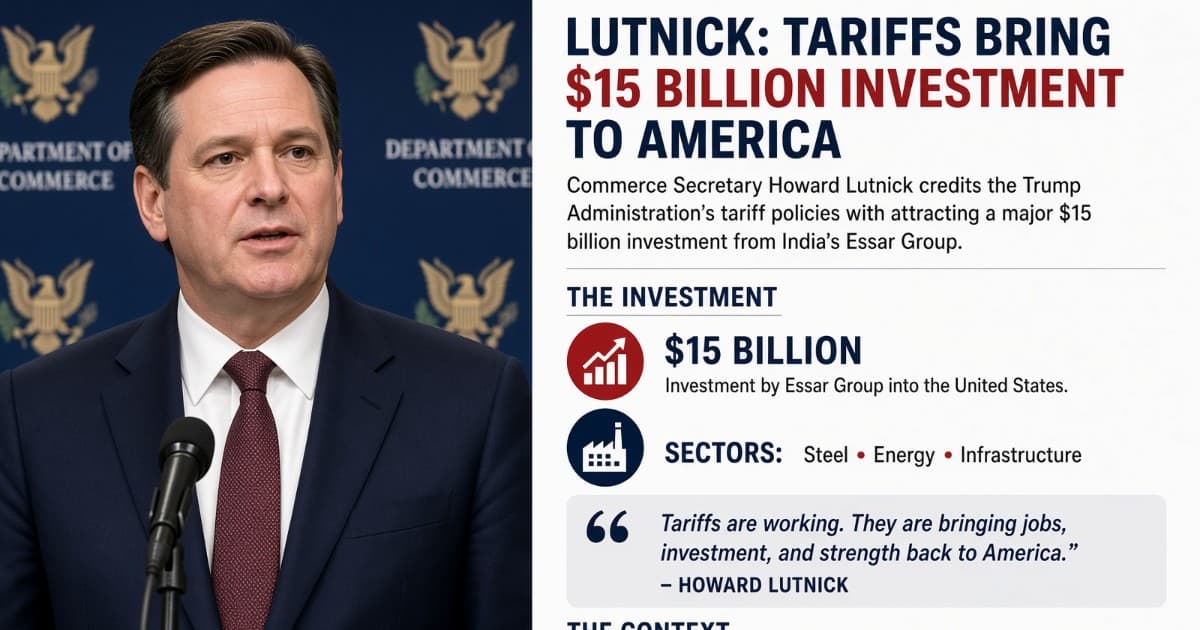
Breaking News
Lutnick Says Trump Tariffs Lured $15 Billion Essar Investment to the U.S.
By The Daily Ledger2 min read4 views
Commerce Secretary Howard Lutnick says Trump's tariff policies drove Essar Group to pledge $15 billion in U.S.
Trump Aide Credits Tariffs for Essar Group's $15-Billion U.S. Investment Pledge
Commerce Secretary Howard Lutnick has publicly attributed a reported $15-billion investment commitment from Indian conglomerate Essar Group to the Trump administration's tariff policies, framing the announcement as evidence that aggressive trade measures are drawing large-scale foreign capital into the United States.
Lutnick, who served as chief executive of financial services firm Cantor Fitzgerald before joining the administration, has emerged as one of the more outspoken defenders of the White House's trade agenda. His remarks connecting the Essar pledge directly to tariff policy reflect a broader argument the administration has made repeatedly: that imposing duties on imported goods compels foreign companies to invest in American production rather than ship finished products across the border.
Essar Group is a diversified Indian conglomerate with business interests that include steel, energy, and infrastructure. The company has maintained an international presence across multiple continents, and a commitment at the scale of $15 billion would represent a substantial addition to its U.S. footprint. The precise terms of the investment — including its timeline, the sectors it would target, and whether it constitutes a binding agreement or a statement of intent — had not been fully detailed in public reporting at the time of Lutnick's comments.
The announcement arrives as the United States and India are navigating a complex trade relationship. Washington has applied tariffs to a range of Indian goods, and New Delhi has at times responded in kind, making the prospect of major Indian investment in the American market a point of potential diplomatic as well as economic significance.
Critics of the administration's trade approach have long questioned whether tariffs are the primary driver behind individual investment decisions, arguing that companies weigh a wide range of factors — including labor costs, regulatory environments, proximity to customers, and supply chain logistics — when committing large sums of capital. Independent economists have generally been cautious about attributing specific corporate decisions solely to trade policy changes.
The White House has made a practice of highlighting large foreign investment pledges as political validation of its economic strategy. Announcements from manufacturers in the automotive, semiconductor, and energy sectors have all been cited by administration officials in recent months as proof that tariffs are reshaping global capital flows in America's favor.
Essar's potential investment, if realized, would add to a list of high-profile commitments the administration has publicized. Whether the $15 billion figure translates into verified capital expenditure — and on what schedule — will likely be scrutinized by lawmakers and analysts in the weeks ahead.
##DonaldTrump #TrumpNews #BreakingNews #HotNews #USA #AmericanNews #5000Dollars #StimulusCheck #GovernmentNews #USNews #LatestNews #TrumpAnnouncement #AmericanCitizens #FinancialUpdate #NewsToday
Comments (0)
No comments yet. Be the first to share your thoughts.
Leave a comment
Comments are reviewed before they appear.