 Breaking News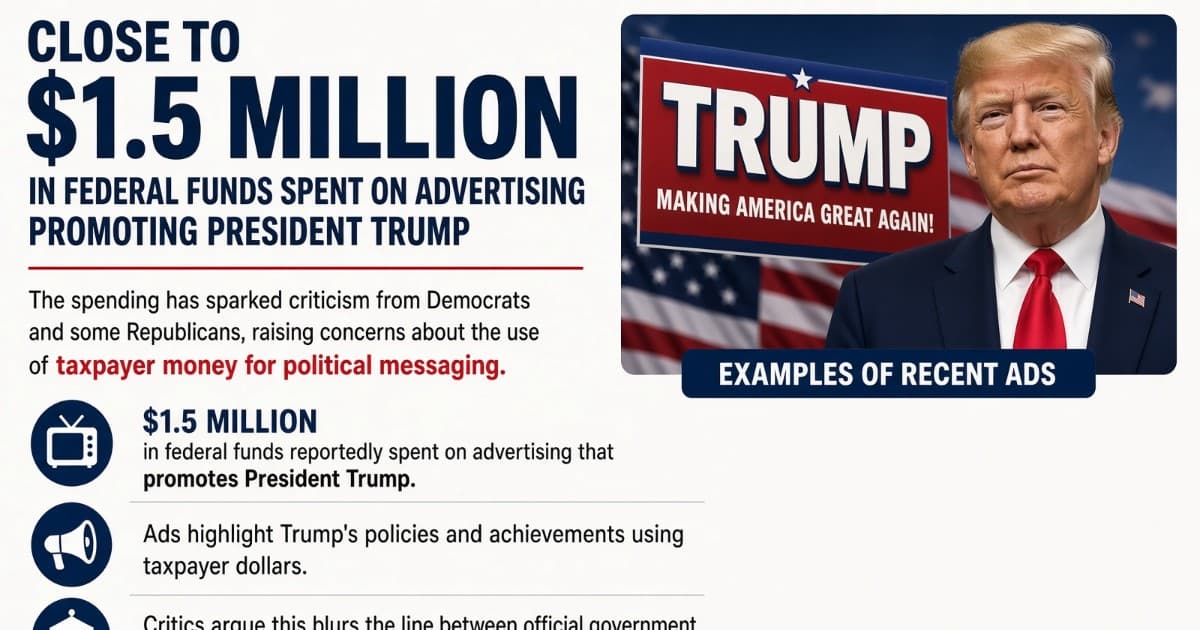
Breaking News
Nearly $1.5 Million in Taxpayer Money Spent on Pro-Trump Ads, Critics Say
By The Daily Ledger2 min read5 views
Close to $1.5 million in federal funds has reportedly been spent on advertising that promotes President Trump, sparking criticism from Democrats and some…
Taxpayer Funds Used for Pro-Trump Ads Spark Bipartisan Criticism
Nearly $1.5 million in federal government money has been spent on advertising that critics say promotes President Donald Trump's image rather than serving a neutral public-information purpose, according to recent reports. The spending is drawing sharp criticism not only from Democrats but also from some members of the president's own Republican Party — a sign that discomfort with the practice extends beyond typical partisan lines.
The advertising, which reportedly ran across multiple media platforms, was paid for through federal agency budgets, meaning it was ultimately financed by American taxpayers. While federal agencies routinely spend public funds on communications campaigns — covering topics such as public health, safety, and government services — critics argue that the ads in question crossed a line by centering on the president himself in ways more consistent with political promotion than official government outreach.
Federal law has long restricted the use of appropriated funds for what is sometimes called official propaganda — communications designed to shape public opinion in favor of a particular political figure or agenda rather than to inform citizens about government programs. Government watchdogs have previously cited administrations of both parties for communications spending that blurred that boundary, though findings of outright illegality have been relatively rare.
The bipartisan nature of the criticism has given the story added political weight. Several Republican lawmakers have reportedly expressed unease, reflecting broader tensions within the GOP over the boundaries of executive authority and the use of public resources. Their willingness to speak out publicly signals that the controversy may be difficult for the White House to dismiss as simple partisan opposition.
Democratic members of Congress have been more pointed in their criticism, with some calling for a formal review by the Government Accountability Office, the independent congressional watchdog agency that investigates how federal funds are spent. Such a review could determine whether the spending violated appropriations law.
Administration officials have defended the advertising as standard government communications intended to inform the public about policy achievements and federal initiatives. That framing is consistent with how presidents of both parties have typically characterized promotional spending by their administrations, though the argument has not satisfied critics who say the ads' content is more personal to Trump than any neutral policy message would require.
The controversy arrives amid a broader national debate about the limits of presidential power and the use of federal institutions to advance political goals. How Congress responds — and whether any formal investigation is launched — could set precedents for how future administrations approach government communications spending.
##DonaldTrump #TrumpNews #BreakingNews #HotNews #USA #AmericanNews #5000Dollars #StimulusCheck #GovernmentNews #USNews #LatestNews #TrumpAnnouncement #AmericanCitizens #FinancialUpdate #NewsToday
Comments (0)
No comments yet. Be the first to share your thoughts.
Leave a comment
Comments are reviewed before they appear.