 Breaking News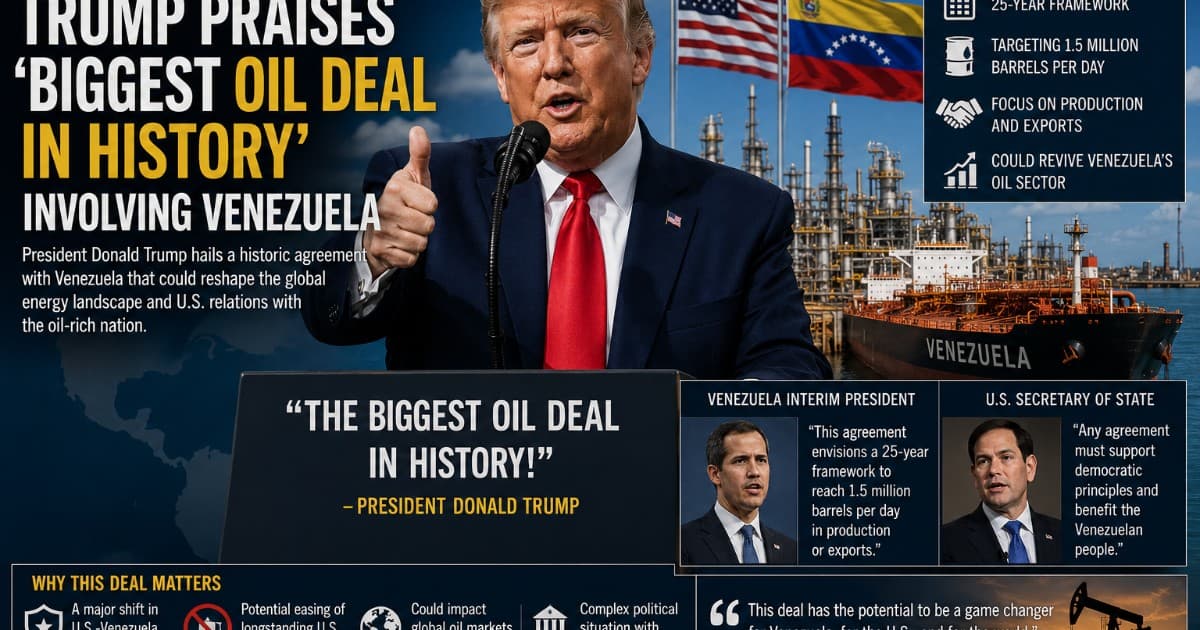
Breaking News
Trump Touts 'Biggest Oil Deal in History' as Venezuela Outlines 25-Year, 1.5 Million BPD Agreement
By The Daily Ledger2 min read66 views
Donald Trump has hailed what he called the biggest oil deal in history, as Venezuela's interim president outlined a 25-year agreement targeting 1.5 million…
Trump Hails 'Biggest Oil Deal in History' Tied to Venezuela
President Donald Trump has publicly celebrated what he described as the biggest oil deal ever struck, with Venezuela's U.S.-recognized interim president outlining the framework of a sweeping 25-year agreement that would aim to produce or export 1.5 million barrels of oil per day.
The announcement marks a striking development in U.S.-Venezuela relations, which have been defined for years by sanctions, political standoffs, and sharply reduced Venezuelan oil output. If the deal moves toward implementation, it would require navigating a complex web of existing American sanctions on Venezuela's state energy apparatus, as well as deep questions about which Venezuelan authority has the legal standing to enter such an agreement.
Venezuela holds some of the largest proven oil reserves in the world, concentrated in heavy crude deposits. The country was once among Latin America's top producers, but output has fallen sharply over the past decade due to underinvestment, economic crisis, and the impact of U.S. sanctions targeting its state oil company. A sustained production level of 1.5 million barrels per day would represent a significant recovery from current output and would require substantial new infrastructure investment.
Trump's framing of the agreement as historically significant fits a broader pattern of the administration seeking high-profile energy partnerships as part of its "energy dominance" agenda. The president did not specify which companies or financial mechanisms would underpin the arrangement.
On the Venezuelan side, the interim leadership — recognized by Washington as the country's legitimate government but holding no territorial control — presented the 25-year timeframe as evidence of the deal's ambition and durability. The practical authority of that leadership to bind Venezuelan state oil assets, however, remains a serious legal and political question, given that the Maduro government continues to control the country and its energy infrastructure.
Analysts have long noted that reaching elevated production targets in Venezuela would demand billions of dollars in capital and years of repair work on aging facilities. Western energy companies have been largely shut out of the Venezuelan market under sanctions, meaning any operational plan would depend heavily on whether, and how quickly, those restrictions are eased.
The deal's announcement is likely to draw attention from global oil markets, where a large new supply source could exert downward pressure on prices — a dynamic that aligns with the Trump administration's stated goal of lowering energy costs. It may also carry geopolitical weight, potentially aiming to reduce Venezuela's reliance on oil partnerships with Russia and China.
Details on the formal structure of the agreement, participating companies, and the timeline for production increases have not been fully disclosed. Congressional and regulatory review of any sanctions modifications would represent a significant step before the arrangement could take practical effect.
Related Stories
Breaking News
Comments (0)
No comments yet. Be the first to share your thoughts.
Leave a comment
Comments are reviewed before they appear.