 World
World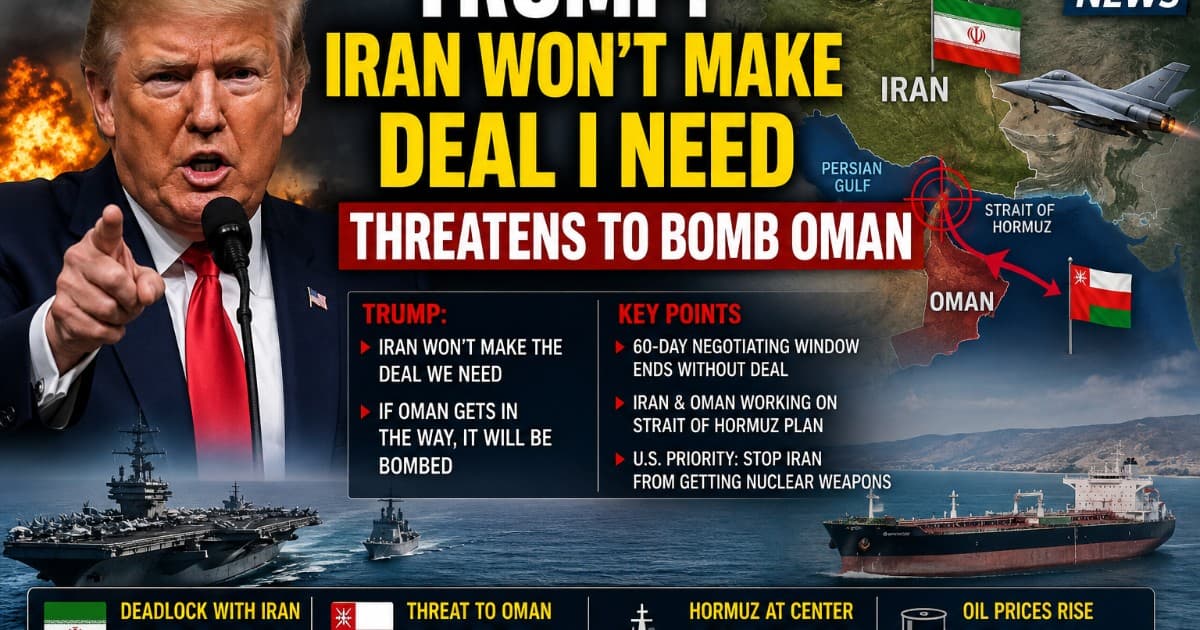
World
Trump Says Iran Won’t Make Deal He Wants, Threatens to Bomb Oman Over Hormuz Dispute
By The Daily Ledger8 min read21 views
President Donald Trump says Iran appears unwilling to accept the agreement he believes is necessary to end the U.S.-Iran war, while issuing an extraordinary threat of military action against Oman if the Gulf ally obstructs U.S. efforts surrounding the Strait of Hormuz.
Trump Says Iran Won’t Make Deal He Wants, Threatens to Bomb Oman Over Hormuz Dispute
President Donald Trump has dramatically escalated his rhetoric surrounding the Iran war, saying he does not believe Tehran will accept the agreement he considers necessary to end the conflict while simultaneously threatening military action against Oman if the Gulf nation interferes with U.S. objectives surrounding the Strait of Hormuz.
Trump made the remarks on Monday, August 17, as a 60-day diplomatic window intended to move Washington and Tehran toward a broader settlement reached its deadline without producing a comprehensive peace agreement.
The comments underscore how rapidly the diplomatic environment surrounding the Iran conflict is deteriorating.
They also introduce a new source of tension involving Oman, a longtime U.S. partner that has historically played an important role as a mediator between Washington and Tehran.
Trump Says Iran Won't Accept the Deal He Wants
Trump expressed deep pessimism about the prospects for reaching the kind of agreement his administration wants with Tehran.
The president indicated that he does not believe Iran will accept the terms he considers necessary for ending the conflict.
A central objective remains preventing Iran from obtaining nuclear weapons.
Trump has repeatedly identified that goal as one of the fundamental reasons behind his administration's strategy toward Tehran.
But the two governments remain divided over several major issues, including sanctions, Iran's nuclear program, military pressure and control of shipping through the Strait of Hormuz.
The failure to resolve those disputes has left the diplomatic process increasingly uncertain.
60-Day Diplomatic Window Ends
The timing of Trump's comments is significant.
Washington and Tehran had established a temporary diplomatic framework in June that provided a 60-day period for efforts toward a broader settlement.
That deadline arrived Monday without the comprehensive agreement negotiators had hoped to achieve.
The temporary framework had already come under significant strain, with both sides accusing the other of failing to meet commitments.
The United States has now indicated that it is not seeking simply to extend the existing arrangement.
That raises a fundamental question about what replaces it.
Washington could increase economic pressure, maintain military pressure, pursue a new diplomatic framework or combine all three approaches.
Trump Issues Extraordinary Warning to Oman
Trump's comments about Oman were particularly striking.
The president threatened military action if Oman interferes with U.S. efforts surrounding the Iran conflict and the Strait of Hormuz.
The threat is unusual because Oman has traditionally maintained friendly relations with the United States while also serving as an important diplomatic intermediary with Iran.
Muscat has frequently helped facilitate indirect communication between Washington and Tehran during periods when direct negotiations were politically difficult.
Threatening Oman therefore risks complicating one of the diplomatic channels that has historically helped prevent U.S.-Iran tensions from escalating further.
Why Oman Is Involved
Oman's geographic position makes it particularly important to the current crisis.
Iran and Oman sit on opposite sides of the Strait of Hormuz.
The waterway connects the Persian Gulf with the Gulf of Oman and the wider Arabian Sea.
That makes both countries directly relevant to questions about navigation through the strait.
Iran announced Monday that it had reached an understanding with Oman concerning a proposed route for ships passing through the strategically important waterway.
Officials were still working to finalize details.
The proposed arrangement could potentially help restore more predictable commercial shipping.
However, Washington's position on any final Iran-Oman framework will be critical.
The Strait of Hormuz Is at the Center of the Conflict
The Strait of Hormuz has become one of the most consequential elements of the U.S.-Iran confrontation.
Before the current conflict, roughly a fifth of globally traded oil and natural gas passed through the waterway.
Any prolonged disruption therefore has consequences far beyond Iran, Oman and the United States.
Asian and European economies depend heavily on energy transported from the Persian Gulf.
Shipping companies also face higher insurance, security and transportation costs when the waterway becomes dangerous.
That is why reopening Hormuz to predictable commercial traffic has become such an important objective.
Iran and Oman Seek Their Own Arrangement
Iran's discussions with Oman add another layer of complexity.
Tehran wants any arrangement governing the strait to reflect its security and political interests.
Oman has an interest in restoring stability and protecting international shipping.
Washington wants freedom of navigation while maintaining pressure on Tehran.
Those objectives are not necessarily identical.
The central question is whether an Iran-Oman agreement can satisfy enough American requirements to become part of a wider settlement.
Trump's warning suggests Washington does not intend to accept an arrangement it believes undermines U.S. objectives.
A Remarkable Threat Against a U.S. Partner
Oman is not normally treated as an American adversary.
The country has maintained longstanding security and diplomatic relations with Washington.
It has also built a reputation for maintaining communication with governments that do not have strong relations with the United States.
That has made Oman particularly useful during previous U.S.-Iran diplomatic crises.
Trump's threat therefore represents a significant escalation in rhetoric toward a country that has generally attempted to play a mediating role rather than directly confronting Washington.
Whether the comments translate into an actual change in U.S. policy remains unclear.
Iran Is Also Escalating Its Rhetoric
Washington is not the only side increasing pressure.
Iran has warned that its military posture could become substantially more offensive if diplomacy fails.
Iranian officials have also threatened additional action related to the Strait of Hormuz.
That creates a dangerous cycle.
Washington increases pressure on Tehran.
Tehran responds with military warnings.
The United States then faces pressure to demonstrate that its own threats are credible.
Each step reduces the political space available for compromise.
Nuclear Weapons Remain Trump's Central Concern
Despite the growing dispute surrounding Hormuz, Trump continues to emphasize Iran's nuclear capabilities.
The administration's stated objective is to prevent Tehran from acquiring a nuclear weapon.
That issue is substantially more difficult to resolve than the immediate shipping crisis.
Military strikes can damage nuclear infrastructure.
Sanctions can make financing and procurement more difficult.
But neither automatically produces a permanent political settlement.
Any durable solution would likely require some combination of restrictions, inspections, monitoring and diplomacy.
That is why negotiations remain important even as relations deteriorate.
Economic Pressure Could Increase
Washington also has powerful economic options available.
The Trump administration is considering additional measures targeting Iran's oil revenue and international financial relationships.
Companies purchasing Iranian crude could face additional pressure.
Foreign banks processing transactions involving Tehran could also become targets of sanctions.
Such measures would allow Washington to increase pressure without immediately expanding military operations.
However, economic sanctions can take considerable time to change a government's strategic calculations.
Oil Markets Face Growing Uncertainty
The diplomatic breakdown is already affecting energy markets.
Oil prices climbed Tuesday as hopes for a U.S.-Iran peace agreement faded.
Reuters reported Brent crude rising above $91 per barrel and U.S. West Texas Intermediate above $85 as investors assessed increasing risks to energy supplies.
Shipping through Hormuz has also slowed dramatically.
The combination of military threats, stalled diplomacy and uncertainty surrounding maritime access increases the risk premium attached to global energy markets.
Trump's Strategy Faces a Difficult Test
Trump now faces a complicated strategic problem.
Increasing military pressure could force Tehran to reconsider its position, but it could also expand the conflict.
Increasing sanctions could weaken Iran economically, but Tehran may attempt to endure them.
Offering concessions could reopen diplomacy, but Trump may believe that would reward Iran's strategy.
And threatening Oman could pressure Muscat over its Hormuz negotiations while simultaneously damaging an important diplomatic relationship.
There is no risk-free option.
What Happens Next?
Several developments will determine the next phase.
The first is whether Iran and Oman finalize their Strait of Hormuz arrangement.
The second is whether Washington accepts, rejects or attempts to modify that framework.
The third is whether Tehran follows through on threats to adopt a more offensive military posture.
Washington must also decide whether to intensify economic pressure now that the 60-day diplomatic period has ended.
Any military incident involving U.S. forces, Iranian forces or commercial shipping could dramatically accelerate events.
Bottom Line
President Trump's latest comments highlight how far the U.S.-Iran confrontation remains from a durable settlement.
Trump says he does not believe Iran will make the agreement he considers necessary to end the conflict.
At the same time, he has threatened military action against Oman if the longtime U.S. partner interferes with American objectives surrounding the Strait of Hormuz.
The remarks come as Iran and Oman work on their own arrangement for shipping through the strategically critical waterway.
That creates an increasingly complicated geopolitical confrontation involving not only Washington and Tehran but also neighboring states trying to manage the economic and security consequences of the war.
The 60-day diplomatic window has ended without a comprehensive agreement.
Now the question is whether Washington and Tehran can construct a new path toward negotiations — or whether increasingly aggressive threats will push the region toward another escalation.
This article reflects verified reporting available on August 18, 2026. Trump's remarks constitute a threat; they do not mean the United States has attacked Oman or that such an attack has been ordered.
Comments (0)
No comments yet. Be the first to share your thoughts.
Leave a comment
Comments are reviewed before they appear.