 Breaking News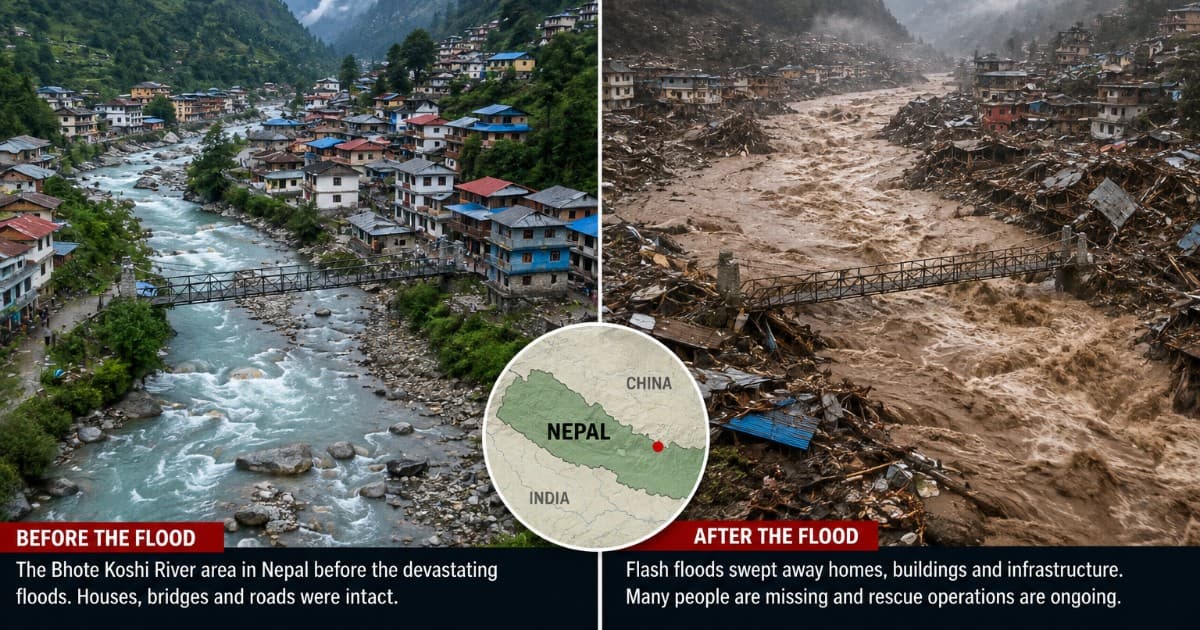
Breaking News
Nepal Flood Disaster Worsens: Before and After Images Reveal Scale of Himalayan Devastation
By The Daily Ledger2 min read44 views
Catastrophic flooding has devastated Himalayan communities in Nepal, destroying homes, bridges and roads while rescue teams search for people reported missing. Before-and-after imagery illustrates the extraordinary scale of the destruction.
Nepal Flood Disaster: Before and After Images Reveal Scale of Himalayan Devastation
A catastrophic flood has transformed parts of Nepal's Himalayan landscape, destroying homes and infrastructure and leaving rescue teams searching for people reported missing.
Before the disaster, communities in the affected mountain region were surrounded by steep green slopes, with homes, roads and bridges built alongside fast-flowing Himalayan rivers.
After the flooding, parts of the landscape have been overwhelmed by muddy water, debris and damaged structures.
Image note: The before-and-after image accompanying this article is an editorial visualization designed to illustrate the reported scale of the disaster. It should not be interpreted as authenticated before-and-after photography of the exact same location.
Search for Missing People Continues
The disaster has triggered a major search-and-rescue operation as authorities attempt to locate residents and travelers who were in affected areas when the flooding struck.
Foreign tourists have also been reported among those unaccounted for, adding an international dimension to the emergency.
Because missing-person figures can change rapidly as communications are restored and travelers make contact with authorities, early numbers should not automatically be interpreted as confirmed casualties.
Communities and Infrastructure Hit
Floodwaters and debris have damaged homes, roads, bridges and other infrastructure across affected Himalayan communities.
Mountainous terrain is making the emergency particularly difficult. Damaged roads can leave communities isolated, while poor weather and unstable slopes complicate access for ground rescue teams.
The destruction also demonstrates how quickly Himalayan river valleys can become dangerous when extreme rainfall, landslides, debris flows or other high-altitude events send large volumes of water and material downstream.
Rescue Operations Underway
Emergency personnel have been deployed to affected areas, with rescuers working to locate survivors and reach communities cut off by damaged transportation links.
Helicopters can play a critical role in such operations because some locations may be inaccessible by road.
Teams must also contend with continuing rainfall, fast-moving water, unstable ground and the possibility of additional landslides.
International Concern
The presence of foreign travelers has prompted governments and families outside Nepal to seek information about their citizens.
Nepal is one of the world's leading trekking destinations, attracting large numbers of international visitors to remote Himalayan regions every year.
The disaster is therefore also raising renewed questions about emergency communications, evacuation procedures and tourist safety during periods of severe weather.
Full Scale Still Emerging
Authorities are continuing to determine how many people have been killed, injured, rescued or remain missing.
Those figures may change as previously isolated communities regain communications and search teams reach additional areas.
For families awaiting information about missing relatives, the emergency remains far from over.
Rescue operations are continuing while Nepal begins confronting the enormous task of helping survivors, restoring essential infrastructure and assessing the full extent of the destruction.
#Climate
Related Stories
Breaking News

Comments (0)
No comments yet. Be the first to share your thoughts.
Leave a comment
Comments are reviewed before they appear.