 Breaking News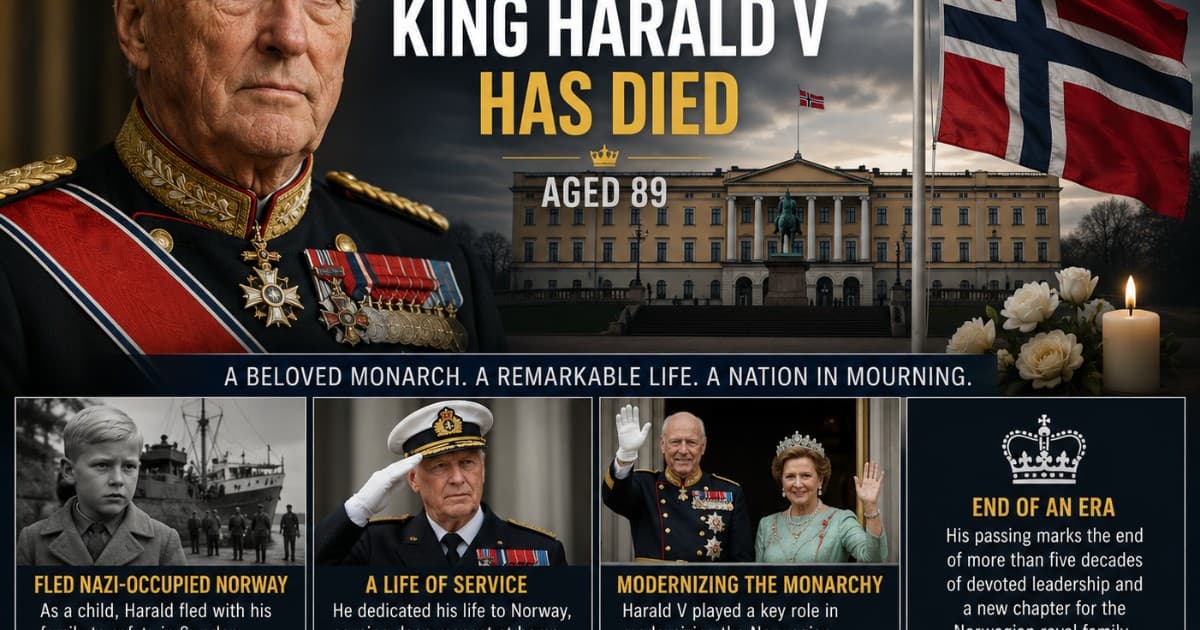
Breaking News
King Harald V of Norway Dies at 89, Leaving Legacy of Resilience and Royal Reform
By The Daily Ledger3 min read51 views
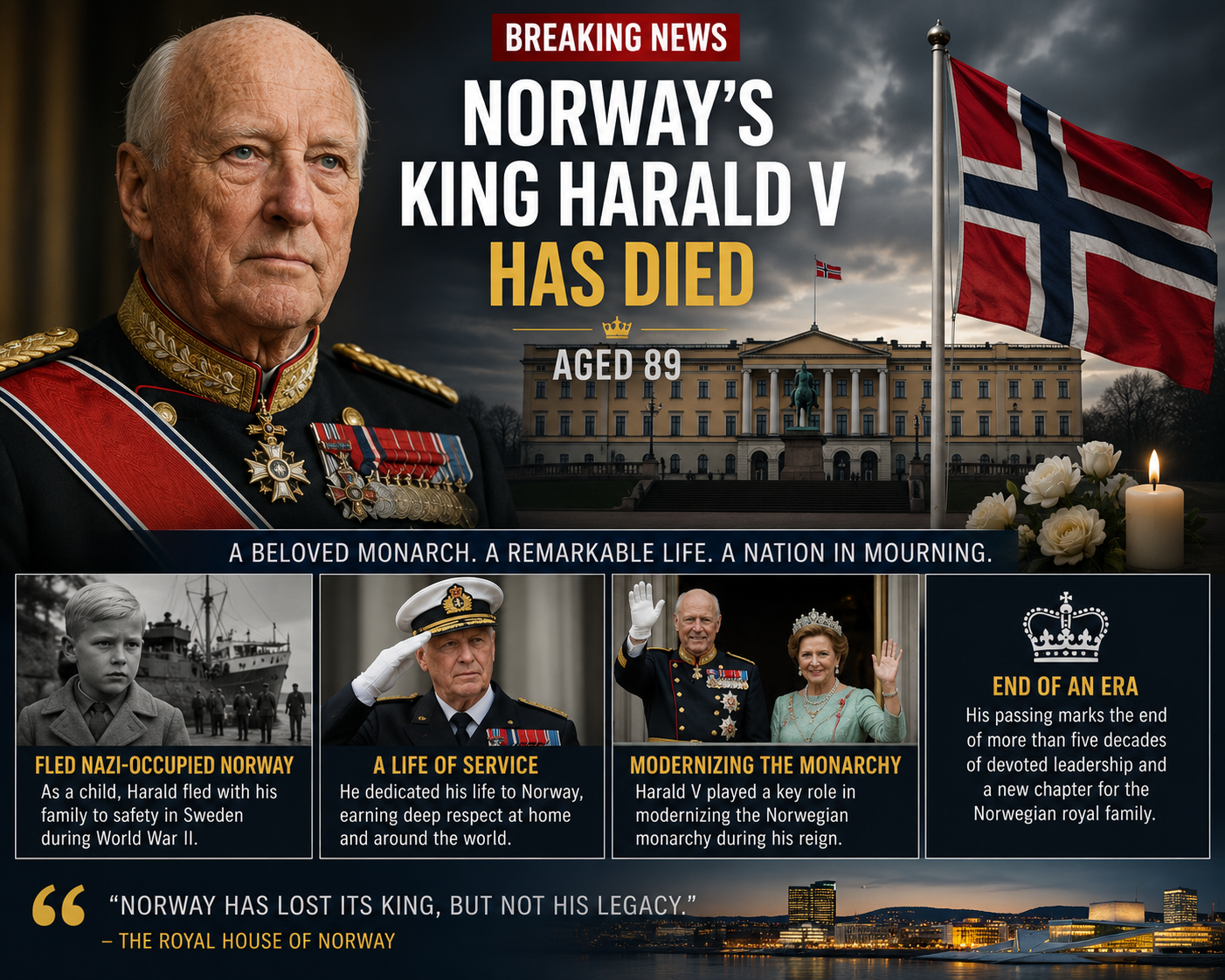
King Harald V of Norway, who fled the Nazi occupation of his country as a child and later steered the monarchy into the modern era, has died at 89.
Norway's King Harald V, Who Fled Nazis as a Child and Modernized the Monarchy, Dies at 89
King Harald V of Norway, a monarch whose life traced an extraordinary arc from wartime exile to the quiet transformation of one of Europe's oldest royal institutions, has died at the age of 89.
Harald was born in 1937 into a Norway that, within a few years, would be shattered by invasion. When Nazi Germany occupied the country in April 1940, the royal family fled rather than capitulate. The young Harald spent his early childhood in exile, part of it in the United States alongside his mother, Crown Princess Märtha, whose presence there helped sustain Norwegian morale and diplomatic ties during the occupation. His father, Crown Prince Olav, divided his time between Britain and the Norwegian government-in-exile. The family returned home in 1945 to a liberated and celebrating Norway.
That childhood experience of displacement and return gave Harald a particular resonance with the Norwegian public throughout his decades as king — a living connection to the country's most painful modern chapter and its ultimate survival.
He ascended to the throne in January 1991 following the death of his father, King Olav V, who had himself been deeply admired for his unpretentious manner. Harald continued in that spirit, presiding over the monarchy in a style that suited Norway's distinctly egalitarian culture. He was rarely distant or ceremonial for ceremony's sake, and his reign was marked by a steady effort to keep the crown relevant and trusted without stripping it of its symbolic weight.
Perhaps no decision better illustrated Harald's willingness to challenge royal convention than his marriage. In 1968, after years of public debate and reported private negotiations with his father, Harald married Sonja Haraldsen, a woman without royal or aristocratic lineage. The match was seen as a significant departure from tradition. With time, Queen Sonja became one of the most popular figures associated with the royal house, and the couple's partnership came to be regarded as a genuine love story as much as a constitutional milestone. The precedent Harald set arguably smoothed the path for his son, Crown Prince Haakon, who later married Mette-Marit Tjessem Høiby, also a commoner.
Beyond royal duties, Harald was known for his passion for sailing. He competed at an Olympic level and remained closely identified with the sport throughout his life — an enthusiasm that connected him to a Norwegian public with a deep cultural affinity for the sea and the outdoors.
In his later years, Harald faced a series of health challenges that periodically drew public concern and led to adjustments in his official schedule. Crown Prince Haakon stepped in with increasing regularity to represent the crown at public engagements.
With Harald's death, Haakon is expected to succeed to the throne, continuing a family line that has reigned since the early twentieth century. Norway is expected to observe a period of national mourning. Tributes from heads of state and European royal houses were anticipated to follow swiftly.
Harald leaves behind Queen Sonja, Crown Prince Haakon, and Princess Märtha Louise, as well as grandchildren. His reign lasted more than three decades, spanning a period of significant social change in Norway and across the continent. To many Norwegians, he embodied both memory and continuity — a king who had once been a child in exile and who, for the rest of his life, never seemed to take his country's peace entirely for granted.
Related Stories
Breaking News

Comments (0)
No comments yet. Be the first to share your thoughts.
Leave a comment
Comments are reviewed before they appear.