 Breaking News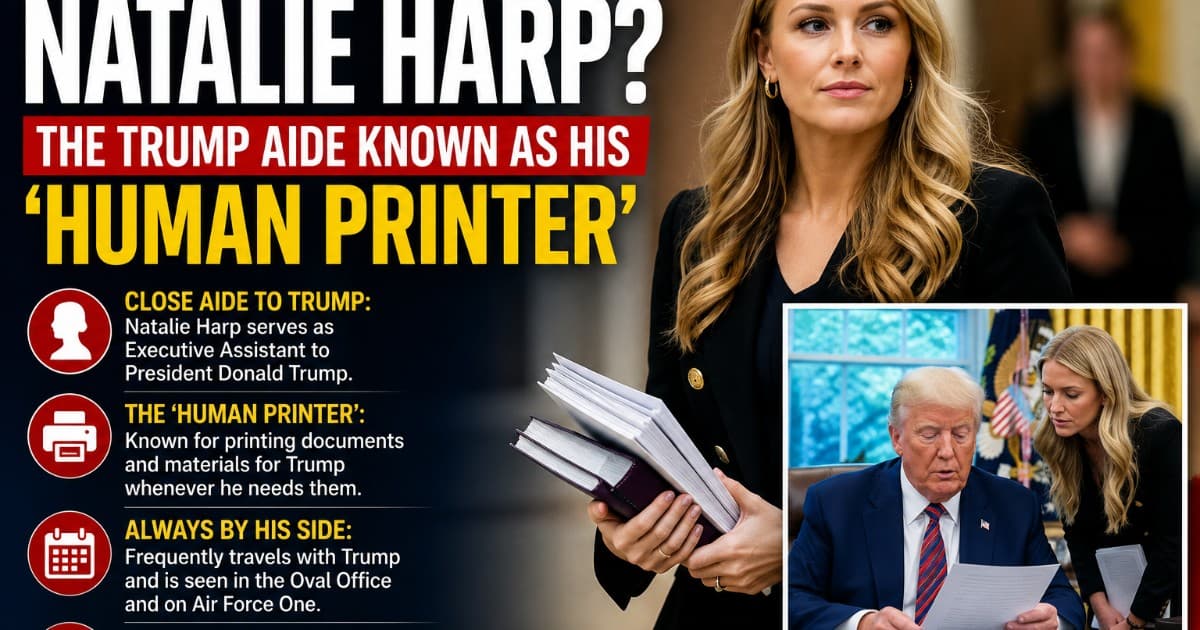
Who Is Natalie Harp? Inside the Trump Aide Known as His ‘Human Printer’
By The Daily Ledger9 min read46 views
Natalie Harp has emerged as one of President Donald Trump’s most closely watched White House aides. The former television presenter, now an executive assistant to the president, earned the nickname “human printer” for carrying a portable printer and supplying Trump with hard-copy news articles and other material — a seemingly simple task that has placed her unusually close to the center of presidential power.
Who Is Natalie Harp? Inside the Trump Aide Known as His ‘Human Printer’
Natalie Harp is not a Cabinet secretary, governor or member of Congress.
Yet she has become one of the most closely watched people surrounding President Donald Trump.
Harp serves as an executive assistant to the president and is frequently seen accompanying Trump during meetings, travel and other presidential activities.
Her unusual role has also earned her one of the most memorable nicknames in Trump’s political orbit:
“The human printer.”
The nickname is surprisingly literal.
During Trump’s 2024 presidential campaign, Harp became known for traveling with a portable printer that allowed her to quickly produce hard copies of news stories, social-media posts and other information Trump wanted to read.
Trump has long been known to consume substantial amounts of information on paper.
Harp became one of the people responsible for making sure those pages reached him.
But describing her simply as someone carrying a printer dramatically understates why she has become politically important.
Her proximity to Trump gives her access few White House employees possess.
From California to Trump’s Inner Circle
Harp’s path to the White House was unconventional.
Before becoming a presidential aide, she worked in conservative media and became publicly associated with Trump during his first administration.
Harp attracted national attention in 2019 when she publicly credited Trump’s support for federal Right to Try legislation with helping her gain access to experimental medical treatment during a serious illness.
Her story caught Trump’s attention.
She subsequently became involved with his political operation and appeared at the 2020 Republican National Convention.
Harp later worked as a television presenter for One America News Network.
Eventually, she returned to Trump’s political organization.
By the 2024 presidential campaign, she had become a regular presence around him.
Why Is She Called the “Human Printer”?
The nickname emerged because of one of Harp’s most distinctive responsibilities.
Trump prefers reading many news stories and social-media posts on paper rather than exclusively on a phone or computer.
Harp accommodated that preference.
She traveled with a portable printer, paper and the equipment necessary to keep it operating while moving between campaign events, court appearances, golf courses and Trump properties.
When Trump wanted to see an article, post or other piece of information, Harp could produce a physical copy.
CNN later described her printing stacks of material for Trump on demand.
That routine earned her the “human printer” nickname among people familiar with the campaign.
It sounds like a relatively minor logistical task.
Politically, however, it could be much more significant.
Information Means Influence
The person deciding which information reaches a president can occupy an important position.
Presidents cannot personally read every newspaper article, television transcript, social-media post or intelligence report produced each day.
Staff members inevitably help filter the enormous flow of information.
Harp’s role therefore attracted attention because she was physically delivering material Trump consumed.
Reporting has described her providing him with news coverage and online material she believed would interest him.
That does not mean Harp independently determines presidential policy.
But her proximity places her in a position where she can potentially influence what information reaches Trump’s desk — or his hands.
That has made journalists increasingly interested in understanding exactly how her role works.
More Than Printing Papers
Harp’s responsibilities reportedly extend beyond physical documents.
She has also been involved with Trump’s social-media operation.
Reporting dating back to the 2024 campaign described Harp helping Trump manage material for Truth Social.
Trump could dictate or approve messages while aides helped turn them into posts.
CNN has subsequently reported that Harp remains closely involved in that information and communications ecosystem.
That combination is unusual.
She can help information flow toward Trump.
She can also help information flow outward from Trump to millions of followers.
A Constant Presence
Another defining feature of Harp’s role is proximity.
She has frequently been photographed or observed near Trump during presidential activities.
During Oval Office meetings, she may sit toward the side of the room with a laptop available.
She has accompanied Trump during travel.
She has also appeared around him at his golf properties.
Recent reporting has again highlighted just how close she remains to the president’s daily operation.
That constant presence has inevitably generated speculation about her influence.
In Washington, access is power.
Someone who can speak with the president regularly may have opportunities that officials with more impressive titles do not.
Trump’s Executive Assistant
When Trump returned to the White House in January 2025, Harp became an executive assistant to the president.
That title helps explain why she is around Trump so frequently.
An executive assistant to a president can be responsible for maintaining information flow, handling documents, assisting with communications and responding rapidly to requests throughout an extremely demanding schedule.
The job inherently requires proximity.
That context is important amid recent political controversy surrounding Harp.
Being regularly seen beside Trump is not, by itself, unusual given the nature of her position.
Why Everyone Is Suddenly Talking About Her
Harp has received renewed national attention following political attacks involving Democratic Sen. Jon Ossoff.
During a campaign speech, Ossoff referenced Harp while criticizing Trump’s priorities and conduct as president.
The remark triggered an intense response from Trump's allies.
Republicans accused Ossoff of making an inappropriate insinuation about a female White House employee.
The controversy subsequently reached the Oval Office when CNN correspondent Kristen Holmes asked Trump about Ossoff’s comments.
Trump reacted angrily, attacking Ossoff and criticizing Holmes.
The White House later escalated its response against the CNN reporter on social media.
Suddenly, a staff member who normally operated behind the scenes was at the center of a national political argument.
Separating Harp’s Job From Political Speculation
The controversy has made careful reporting particularly important.
Harp is demonstrably close to Trump professionally.
She serves as his executive assistant.
She frequently travels with him.
She supplies him with information.
She has reportedly assisted with social-media communications.
Those facts are well documented.
They should not automatically be transformed into allegations about Harp’s private life.
Some recent political commentary and tabloid coverage has gone considerably further, speculating about the nature of her relationship with Trump.
Credible evidence establishing an improper romantic relationship has not emerged from the reporting reviewed for this profile.
Professional proximity and evidence of a romantic relationship are two very different things.
Reports About Personal Notes
Harp has also attracted attention because of reporting in Regime Change, a book by New York Times journalists Maggie Haberman and Jonathan Swan.
The journalists reported that Harp had left Trump highly admiring personal notes.
CNN subsequently discussed those reports while profiling Harp.
Those accounts contributed to questions inside and outside the administration about the intensity of Harp’s loyalty to Trump.
But these details should be presented with attribution.
They originate from journalistic reporting about private communications rather than public statements from Harp explaining those messages herself.
The White House and Trump allies have strongly disputed or criticized broader portrayals of Harp and her relationship with the president.
Loyalty Matters in Trump World
One reason Harp’s position is particularly interesting is Trump’s well-established emphasis on loyalty.
Trump frequently praises people he considers personally loyal and publicly attacks former allies he believes have betrayed him.
Harp has remained with Trump through campaigns, legal battles, his return to the presidency and his second administration.
That longevity distinguishes her from the large number of advisers who have entered and exited Trump’s political orbit.
Her relationship with Trump appears to be built partly on precisely the characteristic he values so highly: unwavering loyalty.
An Unusual Route to Presidential Power
Harp’s career also illustrates how unconventional Trump’s political organization can be.
Traditional presidential aides often rise through predictable institutions.
They may work on Capitol Hill.
They may serve in federal agencies.
They may build careers at major law firms, think tanks or established political consulting operations.
Harp’s path involved conservative television, a personal health story, campaign politics and eventually direct service to Trump.
Her rise was driven less by a conventional Washington résumé than by personal trust and proximity.
That is a recurring feature of Trump's management style.
The Portable Printer Became a Symbol
The printer has consequently become more than an amusing piece of political trivia.
It symbolizes the personalized way information reaches Trump.
Presidents historically receive carefully prepared briefing books from large staffs.
Trump also consumes information through television, social media, printed articles and conversations with people he trusts.
Harp adapted herself to that style.
If Trump wanted something printed, she could print it.
If he wanted an article, she could locate it.
If he wanted information while away from the White House, the system could travel with him.
The result was an information operation built partly around one man's personal habits.
Does the “Human Printer” Have Political Power?
That question is more complicated.
Harp does not possess the formal authority of the secretary of state, defense secretary or White House chief of staff.
She does not independently command agencies or control federal budgets.
But formal authority is not the only form of influence inside a presidency.
Access matters.
Information matters.
Trust matters.
A staff member who spends extensive time near the president and participates in his information flow can potentially possess significant informal influence.
That is why journalists continue examining Harp’s role.
A Window Into Trump’s Presidency
Ultimately, Natalie Harp’s story is interesting not merely because of Natalie Harp.
It provides a window into how Donald Trump operates.
Trump has always maintained an intensely personalized political organization.
Longtime aides, family members and deeply trusted associates can occupy unusually important positions.
Formal organizational charts therefore tell only part of the story.
To understand Trump's White House, observers also have to understand the people he wants physically around him.
Harp clearly belongs to that group.
Bottom Line
Natalie Harp has traveled an unusual path from conservative television personality to one of President Donald Trump’s closest White House aides.
Today, she serves as an executive assistant to the president.
Her nickname — “the human printer” — comes from her practice of carrying a portable printer and producing physical copies of articles, posts and other information for Trump.
But the nickname obscures the larger significance of her position.
Harp sits unusually close to the president’s information and communications operation.
She has helped provide material Trump reads, has reportedly assisted with his social-media activity and regularly accompanies him during presidential business and travel.
That proximity has now placed her at the center of a wider political controversy.
But it is important to distinguish documented facts about Harp’s professional role from speculation about her private relationship with Trump.
What is clear is that Natalie Harp has become one of the less famous but unusually well-positioned figures inside Trump's second White House.
The portable printer may have given her a memorable nickname.
Her access to the president is what makes her important.
#Climate
Related Stories
Breaking News

Comments (0)
No comments yet. Be the first to share your thoughts.
Leave a comment
Comments are reviewed before they appear.