 Breaking News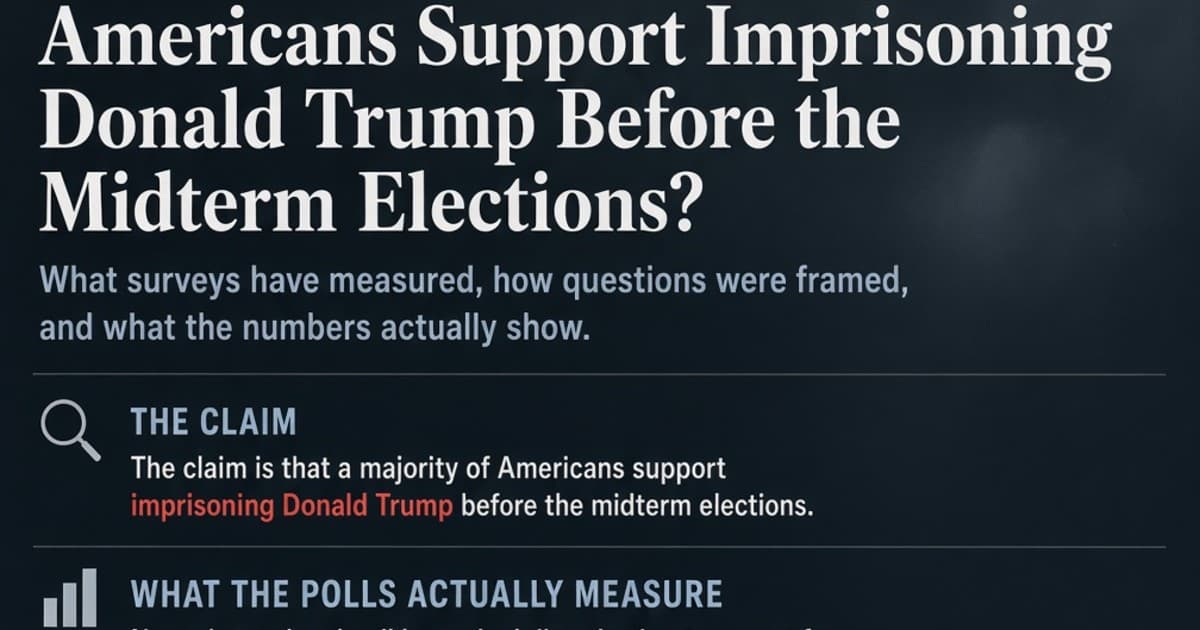
Breaking News
What Do Polls Actually Say About Public Support for Trump Prosecution?
By The Daily Ledger2 min read2 views
Polling on potential criminal consequences for Donald Trump varies widely depending on how questions are asked and which Americans are surveyed.
Claims that polls show a majority of Americans want Donald Trump imprisoned have circulated in political discussions and media coverage. Evaluating this assertion requires a close examination of what surveys have actually measured and how their results align with the claim.
Public opinion polling on Trump and potential legal consequences has produced varied results depending on multiple factors. The way survey questions are worded significantly influences responses. Polls asking whether Americans support "holding Trump accountable" or "prosecuting Trump" may differ from those asking about specific criminal charges, conviction, or imprisonment. Some surveys have focused on whether people think Trump should face legal consequences generally, while others ask about support for imprisonment after conviction.
Partisan affiliation shapes responses dramatically. Support for Trump-related prosecution tends to be substantially higher among Democrats and independents than Republicans, which means the question of what "Americans" collectively support requires careful parsing. A response that appears to show majority support among all respondents might reflect overwhelming support in one partisan group offset by minimal support in another.
Timing also affects polling results. Surveys conducted at different points—before indictments, after charges were filed, or following court hearings—have captured shifting attitudes. Major news developments can influence public opinion in the short term.
When examining specific polling numbers, the distinction between different types of legal outcomes matters considerably. Some polls ask if Trump should be prosecuted; others ask if people think he should be convicted; still others gauge support for imprisonment as a sentence. These represent different thresholds, and public opinion varies across them.
The population being surveyed also affects findings. Results among all American adults, registered voters, and likely voters can differ meaningfully. Additionally, how polling organizations weight their samples and handle methodological choices influences final numbers.
Accurate assessment of this claim requires looking at the specific polls being referenced, examining their exact wording, identifying the respondent population, and checking whether the results actually show majority support for the specific outcome—imprisonment—rather than broader concepts like accountability or prosecution.

Comments (0)
No comments yet. Be the first to share your thoughts.
Leave a comment
Comments are reviewed before they appear.