 Breaking News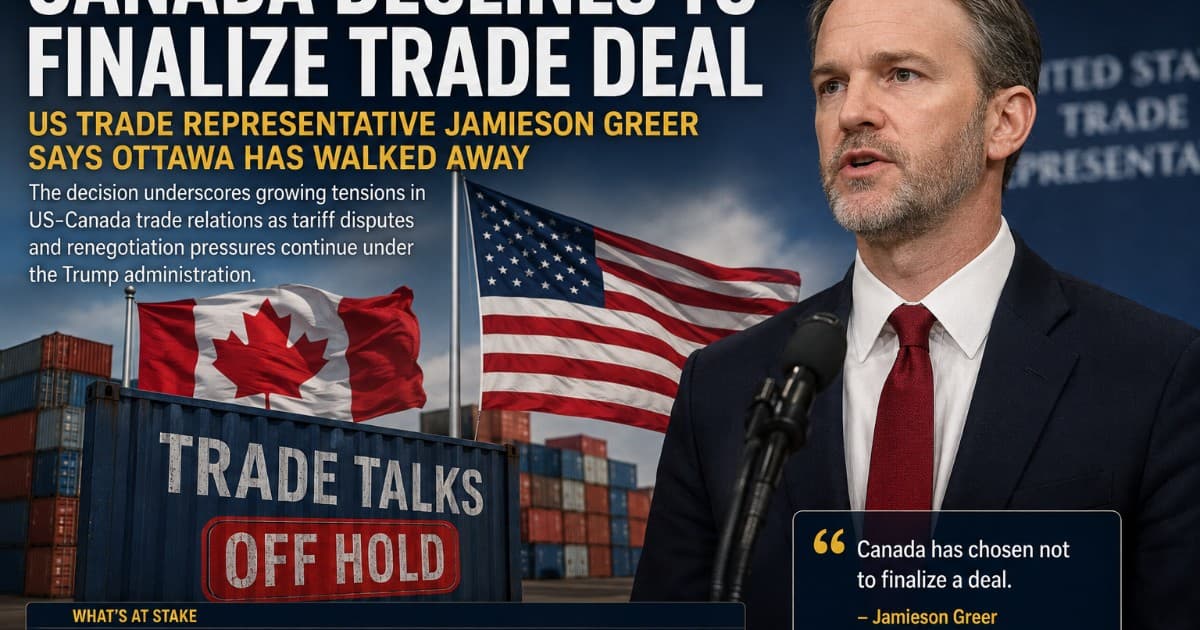
Breaking News
US Trade Representative Greer Says Canada Walks Away From Trade Deal Talks
By The Daily Ledger2 min read51 views
US Trade Representative Jamieson Greer says Canada has refused to finalize a trade deal with Washington, deepening tensions between the two neighbors.
Canada Refuses to Finalize US Trade Deal, Says American Negotiator
The United States and Canada appear to be at an impasse in trade negotiations, after US Trade Representative Jamieson Greer said publicly that Canada has declined to finalize a proposed trade agreement with Washington.
Greer's remarks mark one of the more direct public acknowledgments by a senior Trump administration official that talks between the two countries have stalled. By placing the responsibility on Canada, the statement is likely to escalate pressure on Ottawa at a moment when trade relations between the neighboring countries are already under significant strain.
The two countries have been navigating an increasingly complicated trade relationship since President Donald Trump returned to office, with the administration pursuing an aggressive tariff policy that has drawn retaliatory responses from Canada. Disputes over steel, aluminum, and automotive goods have been among the most contentious flashpoints, and both governments have faced domestic pressure to hold firm at the negotiating table.
Canada and the United States — along with Mexico — are bound by the Canada-United States-Mexico Agreement, the trilateral trade deal that replaced NAFTA during Trump's first term. That agreement includes a built-in review process, and the Trump administration has used the review as an opportunity to push for revised terms. Canadian officials have repeatedly stressed the importance of maintaining a rules-based trade relationship and have been wary of agreeing to conditions that could be seen domestically as concessions made under duress.
For Canada, the political calculus is delicate. Public sentiment has hardened against what many Canadians view as economic coercion from Washington, and any government seen as yielding too readily to American pressure risks significant political backlash. That dynamic has narrowed the room for Canadian negotiators to maneuver.
For the Trump administration, a public declaration that Canada is blocking a deal serves a dual purpose: it signals resolve to a domestic audience and attempts to reframe the breakdown as a failure of Canadian cooperation rather than a product of US tariff pressure.
The economic stakes are considerable. Canada is one of the United States' largest trading partners, and cross-border supply chains — particularly in the automotive and energy sectors — are deeply integrated. A prolonged breakdown in trade talks could introduce uncertainty that businesses on both sides of the border would find difficult to absorb.
Neither government has indicated what immediate steps it plans to take following Greer's statement. The situation is expected to develop as both sides assess their options and respond to growing pressure from industry and trading partners alike.
Related Stories
Breaking News

Comments (0)
No comments yet. Be the first to share your thoughts.
Leave a comment
Comments are reviewed before they appear.