 Breaking News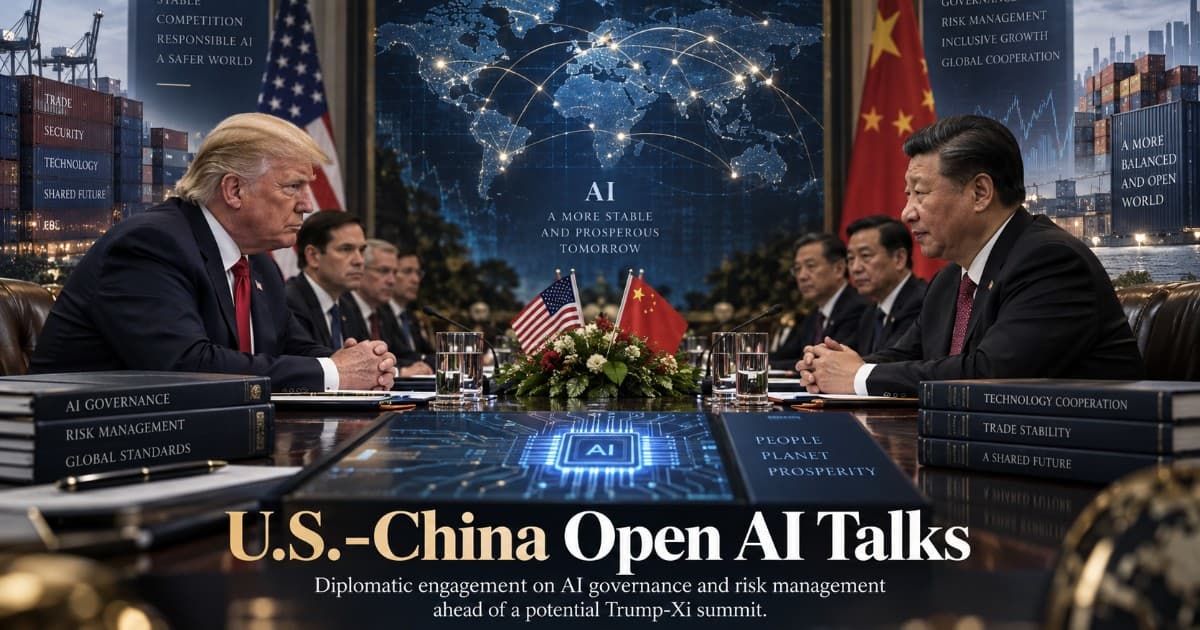
Breaking News
U.S. Opens AI Negotiations with China Ahead of Trump-Xi Meeting
By The Daily Ledger2 min read9 views
U.S. officials are launching direct negotiations with China on artificial intelligence governance and safety protocols, positioning the talks as a foundation…
The United States is preparing to engage China in direct dialogue on artificial intelligence governance, according to officials preparing the groundwork for a potential summit between President Trump and Chinese leader Xi Jinping.
The proposed talks would focus on managing risks associated with AI development and establishing protocols for how the two powers approach critical questions around the technology's military, economic, and social applications. U.S. officials view the initiative as an opportunity to create communication channels on one of the most consequential technology policy issues between Washington and Beijing.
The timing reflects both the strategic importance of AI and the Trump administration's stated interest in direct engagement with China. Rather than viewing AI purely through a lens of competition, the talks would explore whether common ground exists on safety standards, responsible development, and risk mitigation. Such dialogue could help prevent miscalculation in a domain where neither side has clear visibility into the other's capabilities or intentions.
AI governance has become increasingly urgent as both nations accelerate investment in artificial intelligence systems. The technology carries implications for national security, economic competitiveness, and global influence. Without formal communication channels, the risk grows that developments in one country could trigger defensive responses in the other, escalating tensions in an already fraught relationship.
The U.S.-China relationship has been characterized by significant friction over trade, technology, and military issues. AI represents a newer frontier where officials believe establishing norms early might be more feasible than resolving decades-old disputes. International efforts to create AI governance frameworks have largely stalled, leaving bilateral discussions as a potential avenue for progress.
Whether these preliminary discussions lead to substantive agreements remains uncertain. China and the United States have fundamentally different economic systems and strategic priorities, and their AI industries operate under distinct policy regimes. Nevertheless, officials from both sides have indicated that finding common ground on certain AI safety and development principles could serve mutual interests.
The proposed dialogue would add another dimension to preparations for a Trump-Xi meeting, which could address a range of bilateral issues from trade to military operations in contested regions. How the two leaders approach AI governance may shape not only U.S.-China relations but also international norms around one of the most transformative technologies of the coming decades.
Comments (0)
No comments yet. Be the first to share your thoughts.
Leave a comment
Comments are reviewed before they appear.