 Breaking News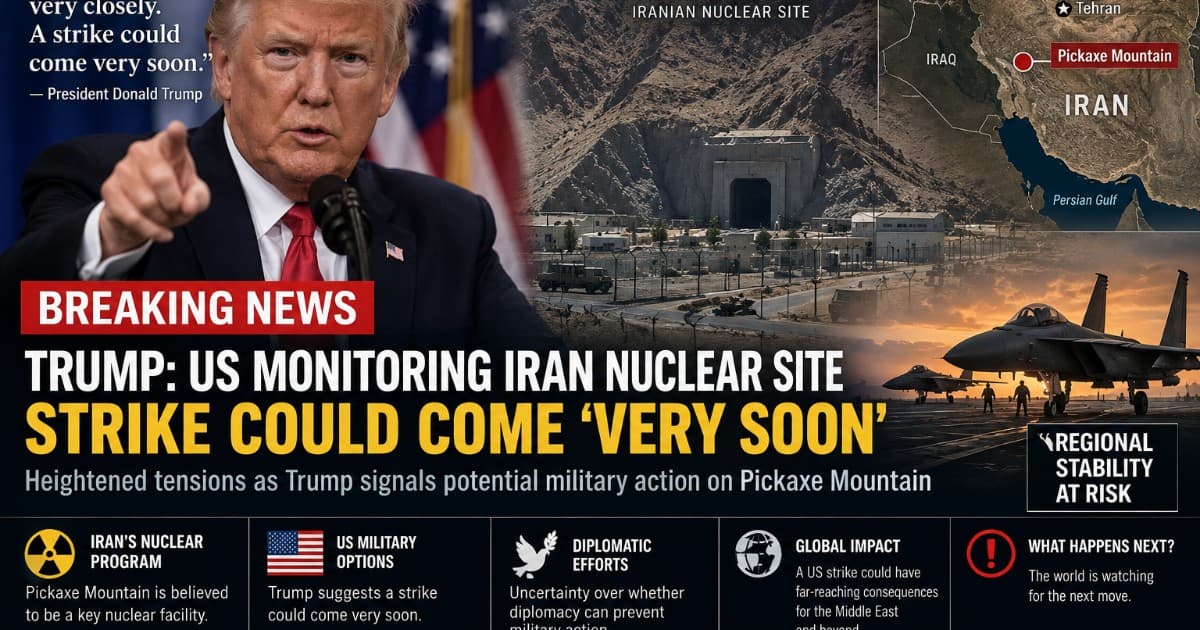
Breaking News
Trump Warns Iran Strike Could Come 'Very Soon' as US Watches Nuclear Site Activity
By The Daily Ledger3 min read2 views
President Trump says the US is closely watching activity at an Iranian nuclear facility and warned a military strike could happen very soon.
Trump Says US Is Monitoring Iranian Nuclear Site, Warns Strike Could Come 'Very Soon'
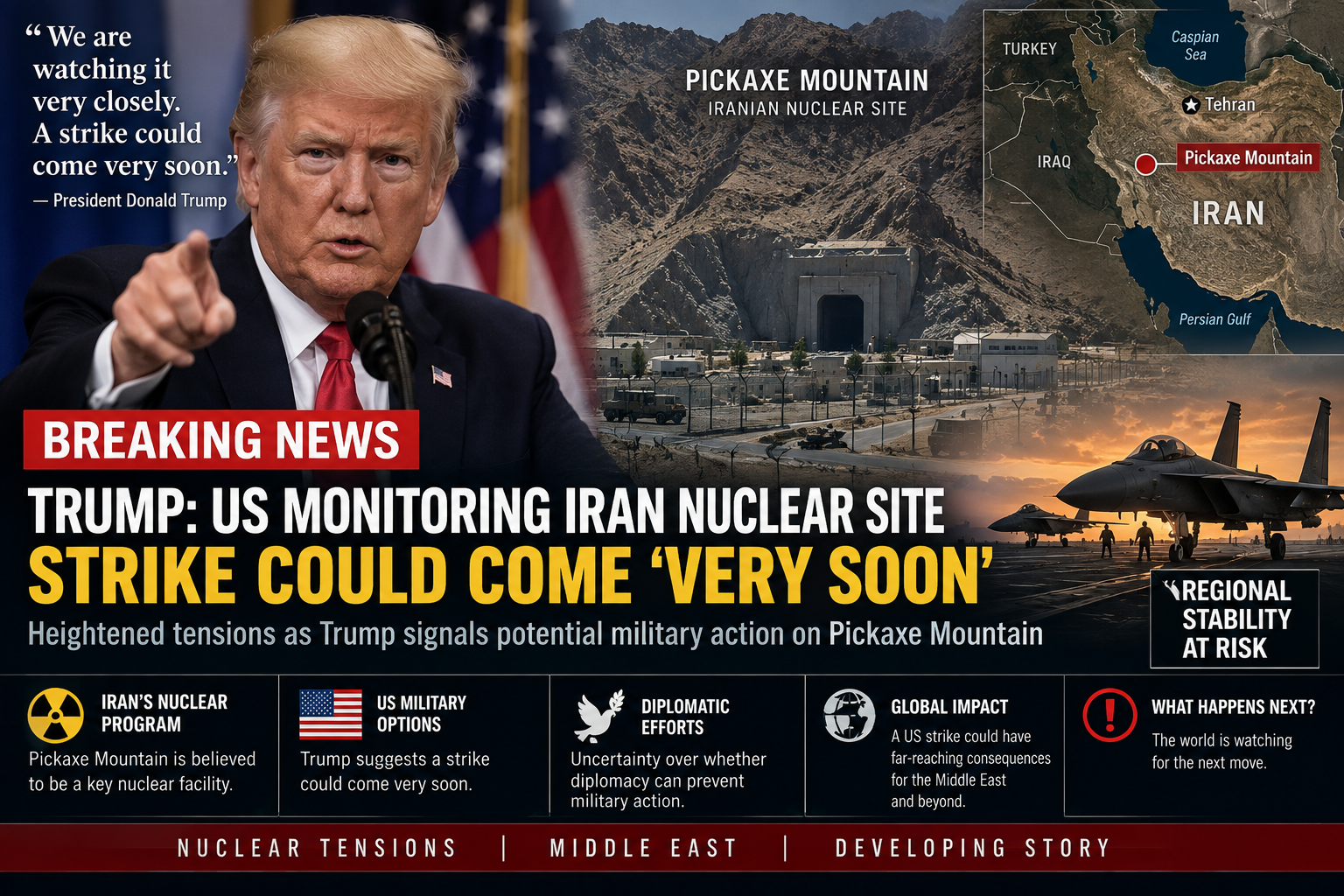
President Donald Trump said the United States is actively monitoring developments at an Iranian nuclear facility he referred to as Pickaxe Mountain, and warned that a military strike on the site could occur in the near future.
The remarks represent one of the most direct public warnings from Trump about potential US military action against Iran's nuclear infrastructure. Speaking with characteristic bluntness, Trump described the situation as serious and suggested that American patience with Iran's nuclear activity was running short.
"Very soon" were the words Trump used to characterize a potential timeline for action, a phrase that prompted immediate attention from foreign policy analysts and governments across the Middle East and Europe.
The reference to Pickaxe Mountain — apparently a reference to a site within Iran's broader nuclear complex — has drawn scrutiny, with analysts working to determine the specific facility Trump was describing and the nature of the activity that has drawn American attention.
Tensions between Washington and Tehran over Iran's nuclear ambitions have escalated steadily in recent years. Iran has advanced its uranium enrichment program well beyond the limits set under the 2015 nuclear deal, from which the United States withdrew during Trump's first term. International inspectors have reported enrichment levels that have narrowed the technical gap between Iran's current capabilities and a potential nuclear weapon, though Iran has consistently maintained that its program remains peaceful.
The prospect of US military action against Iranian nuclear facilities carries significant risks. Some of Iran's most sensitive nuclear infrastructure is housed in heavily fortified underground locations, complicating targeting calculations. A strike would also raise the likelihood of Iranian retaliation against American forces stationed across the region, as well as against US allies including Israel and Gulf Arab states.
Iran has not historically responded passively to perceived military threats, and its network of proxy forces across the Middle East gives it a range of potential retaliatory options short of direct conventional warfare.
Trump's statement came amid broader uncertainty about whether any diplomatic channel between Washington and Tehran remains open. Previous efforts to revive or replace the 2015 nuclear agreement have stalled, and both sides have traded accusations of bad faith in recent months.
Israel, which has long threatened unilateral action against Iran's nuclear program if diplomacy fails, has closely tracked American signals on the issue. Any US decision to strike would likely be coordinated with Israeli officials, though the degree of Israeli involvement in a potential operation remains unclear.
The international community, including European governments that have historically urged restraint and dialogue on the Iran nuclear question, has yet to formally respond to Trump's latest remarks. The United Nations nuclear watchdog has maintained pressure on Iran to increase transparency with inspectors.
Whether Trump's warning reflects imminent operational planning or is intended as diplomatic pressure on Tehran remains an open question — one with consequences that extend well beyond the two countries directly involved.
#Climate


Comments (0)
No comments yet. Be the first to share your thoughts.
Leave a comment
Comments are reviewed before they appear.