 Breaking News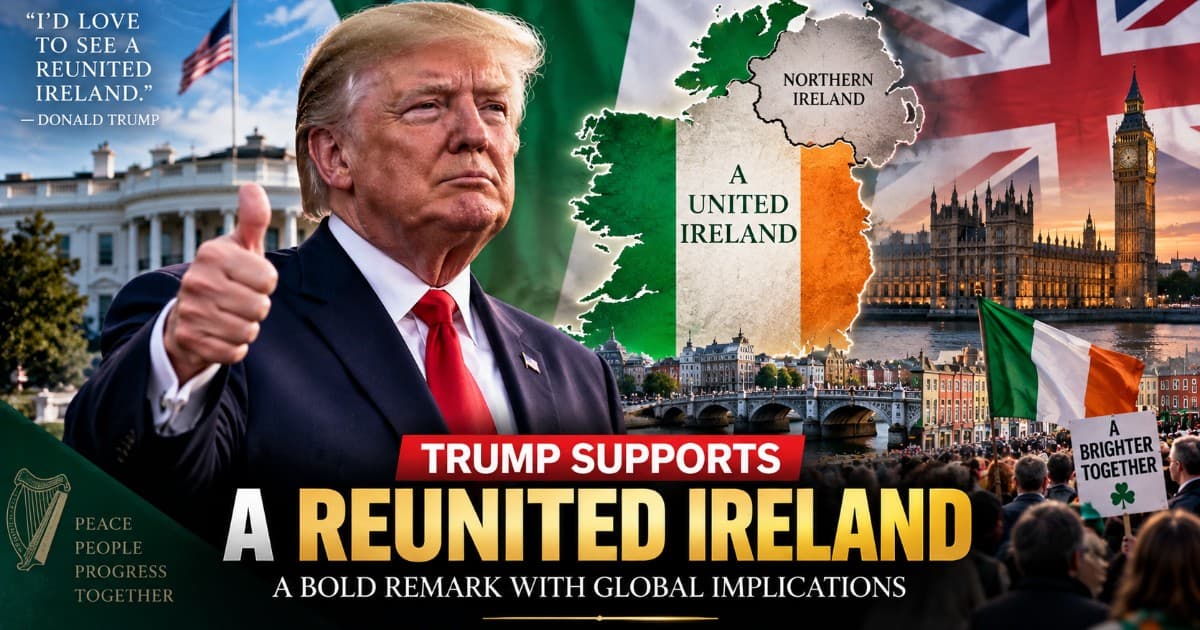
Breaking News
Trump Says He Would 'Love to See' a United Ireland, Wading Into Sensitive Constitutional Debate
By The Daily Ledger2 min read8 views
Donald Trump said he would 'love to see' Ireland and Northern Ireland reunified, wading into one of the most sensitive and enduring constitutional questions in…
Trump Says He Would 'Love to See' a United Ireland
Donald Trump has expressed support for the reunification of Ireland and Northern Ireland, saying he would 'love to see' the two jurisdictions come together — remarks that have drawn immediate attention from governments and political parties on both sides of the Irish border.
The comments represent an unusual departure from the careful diplomatic neutrality that American presidents and senior officials have traditionally maintained on the question of Irish constitutional arrangements. The United States played a central role in brokering the 1998 Good Friday Agreement, which ended decades of sectarian conflict in Northern Ireland, and successive administrations have been cautious not to take positions that could inflame the delicate power-sharing arrangements that followed.
Trump's words landed in a political environment that is already sensitive. Northern Ireland remains part of the United Kingdom, but support for exploring reunification with the Republic of Ireland has grown in recent years, driven in part by the economic and regulatory disruptions that followed Brexit. Under the terms of the Good Friday Agreement, a referendum on Irish unity — commonly referred to as a border poll — can be called if there is sufficient evidence that a majority of people in Northern Ireland would support it.
For unionist and loyalist parties in Northern Ireland, who regard the region's membership of the United Kingdom as a foundational principle, Trump's remarks are likely to be unwelcome. Unionist politicians have long pushed back against what they see as outside interference in Northern Ireland's constitutional future. Nationalist parties, by contrast, who have long argued for reunification, are likely to view the comments more favorably.
The Irish government has historically taken a measured approach to the reunification question, stating support for the principle while emphasizing that any change must come through democratic consent on both sides of the border — a position enshrined in the Good Friday Agreement.
Trump has made no secret of his affinity for Ireland. He has referenced Irish ancestry on his mother's side and has visited the island in the past. However, affinity and formal diplomatic positioning are distinct matters, and observers will be watching closely to see whether his comments reflect a considered policy stance or a more personal, off-the-cuff sentiment.
The remarks come at a time when Washington's relationships with both London and Dublin are in flux, shaped by broader debates over trade, tariffs, and the transatlantic alliance. How the UK government responds will be closely watched, given that any formal shift in US policy toward supporting Irish reunification would represent a significant challenge to British constitutional interests.
Political leaders in Belfast, Dublin, and London are expected to respond in the coming days as the full context of Trump's comments becomes clearer.

Comments (0)
No comments yet. Be the first to share your thoughts.
Leave a comment
Comments are reviewed before they appear.