 Breaking News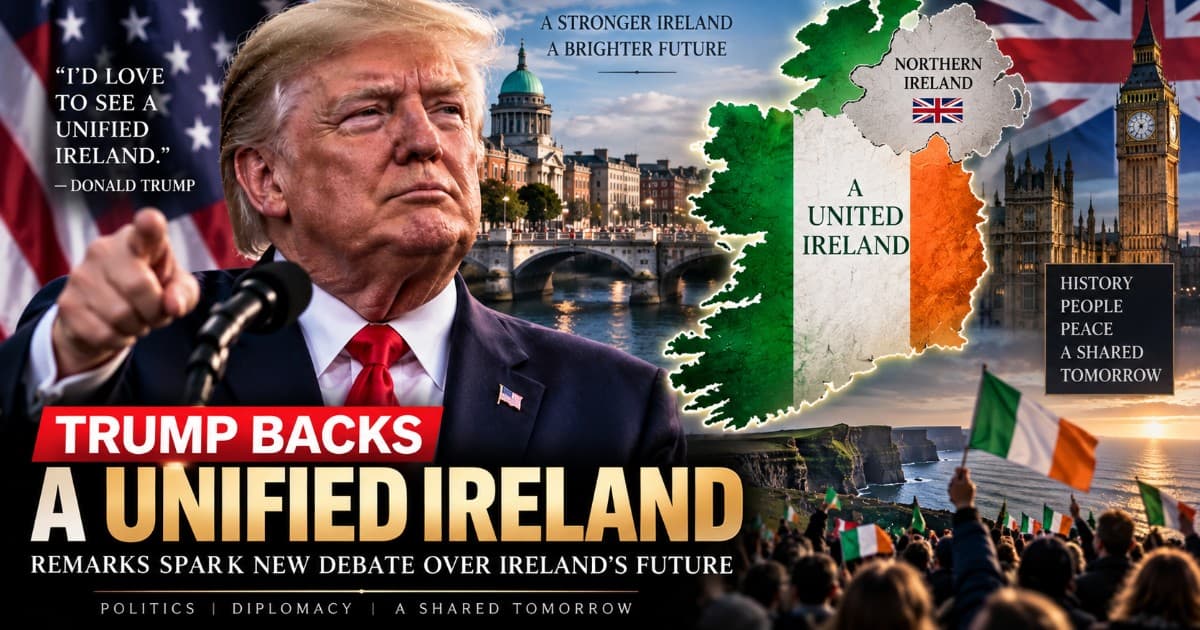
Breaking News
Trump Says He Would 'Love to See' a United Ireland, Stirring Political Debate on Both Sides of the Atlantic
By The Daily Ledger2 min read11 views
Donald Trump has said he would like to see Ireland reunified, remarks that touch on one of the most sensitive constitutional questions in British-Irish…
Trump Says He Would 'Love to See' a Reunified Ireland
Donald Trump has expressed a desire to see Ireland reunified, saying he would "love to see" Northern Ireland and the Republic of Ireland come together — remarks that immediately drew attention from governments on both sides of the Irish Sea and reignited debate over one of the most enduring constitutional questions in European politics.
The comments, made in a characteristically informal tone, touched on a subject that American presidents have historically approached with considerable caution. The United States played a central role in brokering the Good Friday Agreement in 1998, the peace accord that ended decades of conflict in Northern Ireland, and successive administrations have been careful to avoid appearing to favor any particular constitutional outcome for the region.
Ireland was partitioned in 1921, leaving Northern Ireland as part of the United Kingdom while the rest of the island became what is now the Republic of Ireland. The question of reunification has shaped Irish and British politics ever since, and while it remains a live issue — particularly following Brexit, which altered Northern Ireland's relationship with both the UK and the European Union — it is one that involves deeply held and often opposing identities.
The Good Friday Agreement enshrined the principle of consent, meaning that Northern Ireland's constitutional status can only change if a majority of its people vote in favor of doing so. That framework has been treated as a cornerstone of the peace process by governments in London, Dublin, and Washington alike.
Trump's remarks are likely to be welcomed by Irish nationalist and republican politicians, who have long sought reunification, while unionist parties — who support Northern Ireland remaining part of the United Kingdom — are expected to respond critically. The UK government, which is navigating its own relationship with the Trump administration on trade and security matters, faces the delicate task of responding without escalating tensions.
Trump has spoken warmly about Ireland on previous occasions and has business interests there. Whether his latest comments represent a deliberate shift in US foreign policy or reflect a more personal view is not yet clear, and senior officials have not elaborated further on what, if any, policy implications the president's words are intended to carry.
The remarks arrive at a moment when the political situation in Northern Ireland remains carefully managed, with power-sharing institutions sensitive to any signals from outside that might be interpreted as pressure on the region's constitutional future. Analysts are likely to debate whether a sitting US president publicly endorsing Irish unity — even informally — carries weight beyond its rhetorical value, given the historical significance of American engagement in the peace process.
#Climate

Comments (0)
No comments yet. Be the first to share your thoughts.
Leave a comment
Comments are reviewed before they appear.