 Breaking News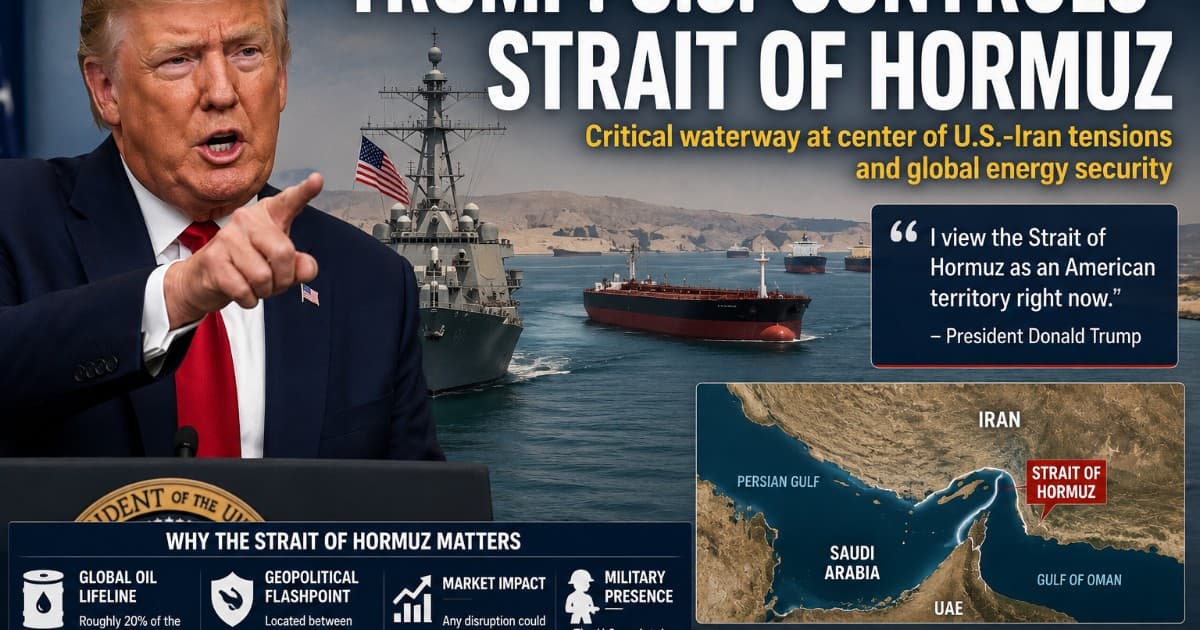
Breaking News
Trump Reaffirms Push for U.S. Control Over Vital Oil Shipping Lane
By The Daily Ledger3 min read47 views
President Trump has doubled down on assertions that the United States should control the Strait of Hormuz, the narrow waterway critical to global oil flows.
Trump Doubles Down on Controlling Strait of Hormuz
President Donald Trump has reiterated his position that the United States should exert control over the Strait of Hormuz, the narrow but enormously consequential waterway through which a substantial portion of the world's oil supply flows each day. The remarks represent an escalation of rhetoric that has drawn attention from energy markets, regional governments, and foreign policy analysts alike.
The Strait of Hormuz sits at the mouth of the Persian Gulf, squeezed between Iran to the north and the Arabian Peninsula to the south. At its narrowest, the passage is only a few dozen miles wide, yet it serves as the primary export route for oil produced by Saudi Arabia, Iraq, the United Arab Emirates, Kuwait, and Iran itself. Disruption to shipping through the strait — whether by military action, blockade, or political instability — would send immediate shockwaves through global energy markets.
Trump's assertion of American control over the waterway is notable both for its boldness and for its legal complexity. Under established principles of international maritime law, the Strait of Hormuz qualifies as an international strait, granting all nations the right of transit passage. Any move toward unilateral U.S. dominance over the route would almost certainly be contested under that framework, and would require navigating the competing claims and interests of Iran, Oman, and the UAE, all of which have coastlines on or near the strait.
Iran, which has long viewed the strait as a potential lever of economic pressure against the West, is likely to interpret such statements as a direct provocation. Tehran has, on multiple occasions over the past two decades, threatened to close the waterway in response to Western sanctions or military pressure, though it has never followed through. U.S. rhetoric about control could complicate any ongoing or future diplomatic efforts related to Iran's nuclear program.
The statement follows a broader pattern in Trump's foreign policy commentary during his return to the White House. He has also spoken forcefully about reasserting American influence over the Panama Canal and has expressed interest in Greenland, suggesting an overall posture that prioritizes physical and strategic dominance of key global arteries and territories.
The United States already maintains a significant naval presence in the Persian Gulf region through the Fifth Fleet, headquartered in Bahrain. American warships have long conducted freedom-of-navigation operations in the area and have historically escorted commercial tankers during periods of elevated tension. Whether Trump's remarks envision a formal expansion of that role or amount to rhetorical positioning remains a subject of debate among defense analysts.
Gulf allies, including Saudi Arabia and the UAE, have strong economic interests in keeping the strait open and stable, and are watching Washington's posture carefully. Major oil-importing nations in Europe and Asia, for whom Hormuz is a critical link in their energy supply chains, are similarly attentive to any development that could threaten the flow of crude.
Oil prices have historically shown sensitivity to tensions in the Persian Gulf, and traders are closely monitoring the diplomatic fallout from Trump's comments.
#Climate
Related Stories
Breaking News

Comments (0)
No comments yet. Be the first to share your thoughts.
Leave a comment
Comments are reviewed before they appear.