 Breaking News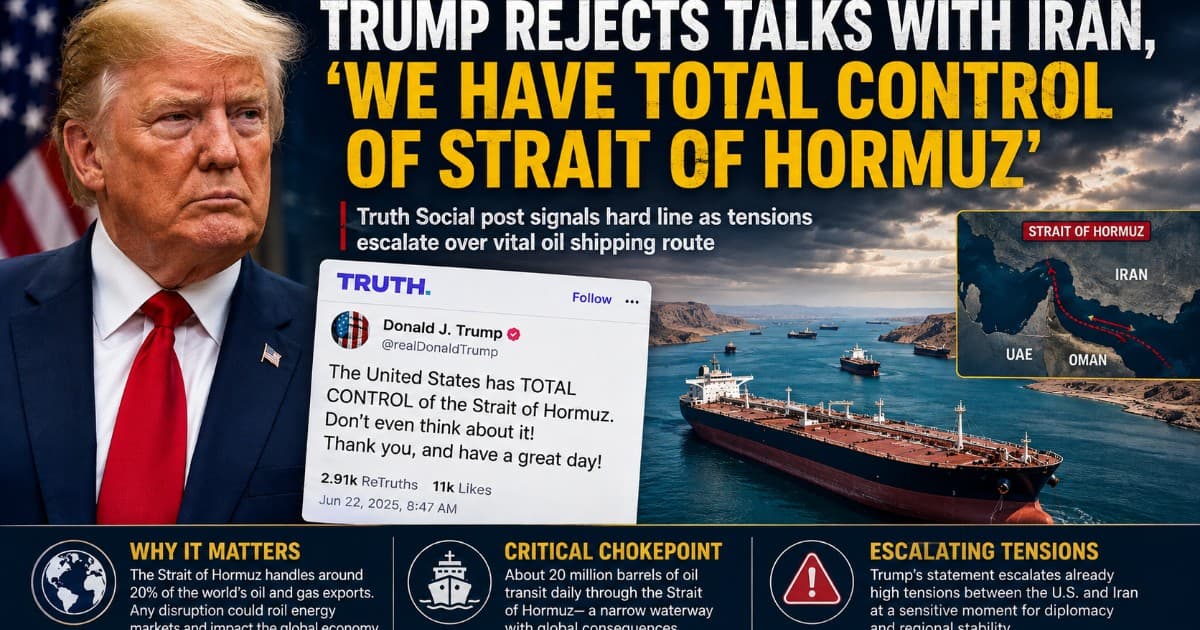
Breaking News
Trump Declares 'Total Control' of Hormuz Strait, Shuts Door on Iran Diplomacy
By The Daily Ledger2 min read4 views
President Trump rejected diplomatic talks with Iran on Truth Social and claimed the US holds total control of the Strait of Hormuz, a critical global oil…
Trump Rejects Iran Talks, Claims US Has 'Total Control' of Strait of Hormuz
President Donald Trump on Tuesday dismissed the possibility of diplomatic engagement with Iran and asserted that the United States holds complete military dominance over the Strait of Hormuz, the narrow waterway through which a substantial portion of the world's seaborne oil supply flows each day.
Trump made the remarks on Truth Social, his preferred platform for announcing major policy positions, signaling what appears to be a significant hardening of the U.S. stance toward Tehran at a moment of already elevated tensions between the two countries.
"We have total control of Hormuz," Trump wrote, according to widely circulated reports of the post, adding that he was not interested in pursuing talks with Iranian officials.
The Strait of Hormuz, which separates the Persian Gulf from the Gulf of Oman, is one of the most consequential chokepoints in global energy trade. Oil and liquefied natural gas exports from Saudi Arabia, Iraq, the United Arab Emirates, Kuwait, and Iran itself must pass through the roughly 33-kilometer-wide navigable channel. Disruption to shipping there has historically sent immediate shockwaves through international energy markets.
The United States has long maintained a formidable naval presence in the Persian Gulf through its Fifth Fleet, based in Bahrain. Iran, however, also possesses significant military assets in and around the strait, including fast-attack boats, submarines, and shore-based missile systems — capabilities its commanders have repeatedly cited when threatening to block the waterway in response to Western pressure.
Trump's assertion of total U.S. control represents a stark rhetorical claim that is likely to draw a sharp response from Tehran, where officials have traditionally treated any suggestion of foreign dominance over regional waters as a matter of national sovereignty.
The rejection of talks comes against the backdrop of longstanding disputes over Iran's nuclear enrichment program. Since the United States withdrew from the 2015 multilateral nuclear agreement during Trump's first term, diplomatic efforts to negotiate a replacement framework have repeatedly stalled. Iran has since advanced its uranium enrichment to levels that Western governments describe as far beyond what is needed for civilian energy purposes.
Oil prices reacted to the renewed uncertainty, though the full extent of any market movement will depend on whether the rhetoric translates into concrete military or policy action. Analysts have long warned that any serious threat to Hormuz shipping could trigger a rapid spike in global energy costs, with cascading effects on economies in Europe and Asia that rely heavily on Gulf oil.
No immediate formal response had emerged from Iranian government officials at the time of writing, though the statement is expected to fuel debate among hardliners in Tehran who have argued that engagement with Washington yields few benefits.
The administration has not yet elaborated through official channels on what specific measures underpin Trump's claim of control over the strait, or whether any military posture changes are being contemplated alongside the diplomatic rejection.

Comments (0)
No comments yet. Be the first to share your thoughts.
Leave a comment
Comments are reviewed before they appear.