 Breaking News
Breaking News
The Questions Donald Trump Won't Answer: Patterns Behind His Press Confrontations
By The Daily Ledger3 min read37 views
Donald Trump's confrontations with reporters follow recognizable patterns. Here's what tends to trigger his sharpest responses and why it matters.
What Triggers Donald Trump to Shut Down Reporters?
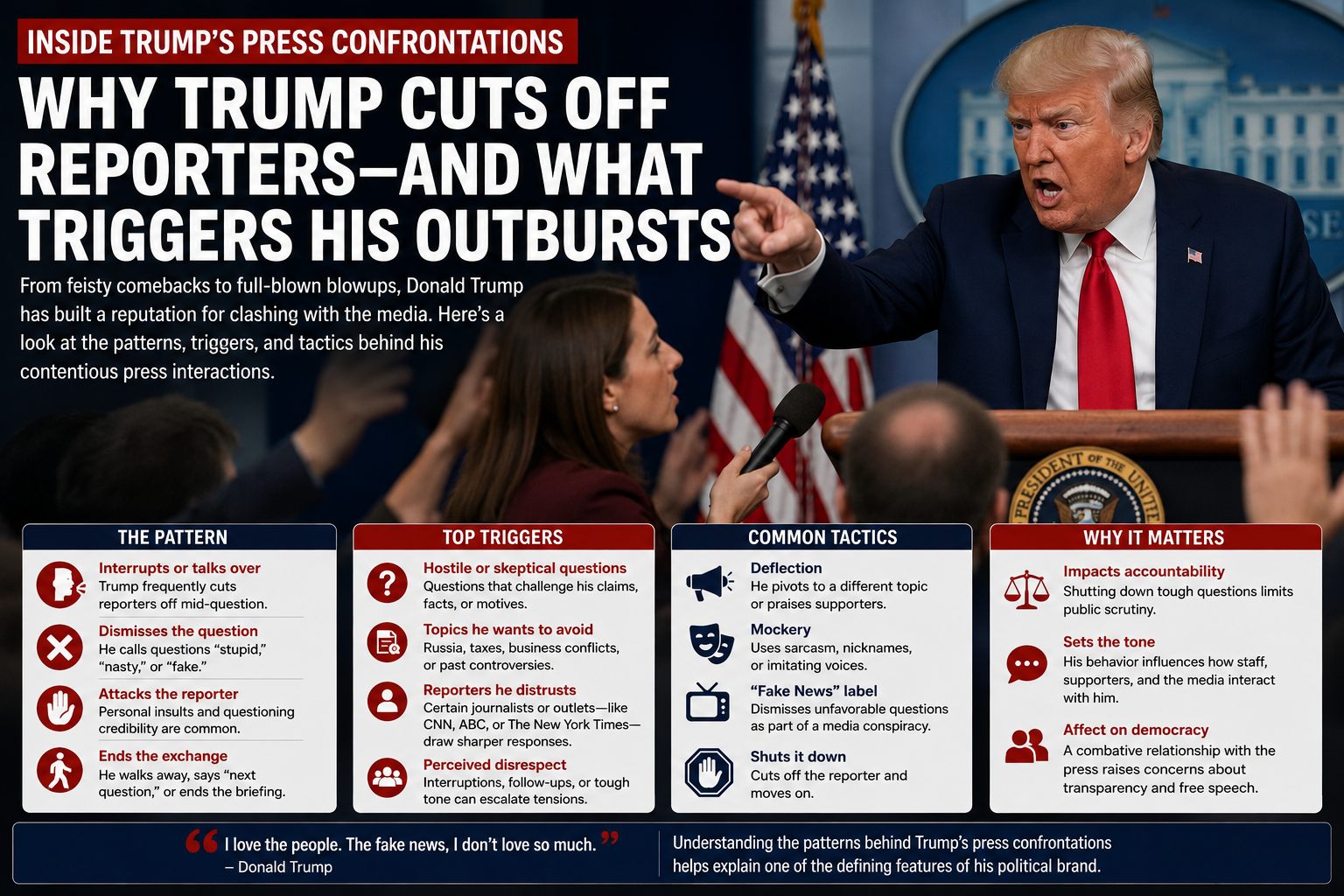
Few figures in modern American political life have had a relationship with the press as openly combative as Donald Trump. Across years of campaign rallies, Oval Office gaggles, and formal press conferences, a recognizable set of patterns has emerged around the moments when Trump cuts a reporter off, walks away, or turns a question into a broadside against the media itself.
Understanding those triggers is not merely an exercise in political theater analysis. For journalists, voters, and democratic accountability, the questions that go unanswered — and the manner in which they are silenced — reveal something meaningful about how a powerful political figure manages scrutiny.
Legal and Personal Liability
Questions that touch on Trump's legal exposure have historically produced some of his most abrupt disengagements. When reporters press on matters related to court proceedings, indictments, or civil judgments, Trump frequently pivots to attacking the question's premise or the outlet asking it, rather than engaging with the substance. The sensitivity is understandable from a legal-strategy standpoint, but it leaves significant gaps in public understanding.
The 2020 Election and Electoral Integrity
Few subjects produce a sharper reaction than questions that challenge Trump's claims about the 2020 presidential election. Reporters who push back on those claims in real time — offering documented facts or court rulings that contradict them — often find the exchange ended quickly, either through redirection or an abrupt departure from the microphone.
Real-Time Fact-Checks
Trump has shown particular irritation when a reporter cites specific data or prior statements that contradict something he has just said. Rather than correcting the record, his typical response is to question the reporter's motives or the credibility of the source they are drawing on. This pattern has been documented repeatedly across both terms in office.
The "Fake News" Label as a Shutdown Mechanism
The phrase "fake news," which Trump helped push into mainstream political discourse, functions in press interactions as much as a conversational off-ramp as a substantive criticism. Attaching that label to a question signals to the room — and to viewers — that he considers the inquiry illegitimate, which allows him to disengage without appearing to concede anything.
Outlet Loyalty and Reporter Relationships
Not all reporters are treated equally. Journalists working for outlets Trump considers hostile face a measurably different experience than those from organizations he views more favorably. Press freedom advocates have raised concerns about this selective access, arguing that it distorts the press corps' ability to function as a neutral accountability mechanism.
Why It Matters
The cumulative effect of these shutdown patterns is a body of questions — about policy, legality, and conduct — that never receive direct answers in public settings. For a figure who has held and seeks to hold the most powerful office in the country, that gap between question and answer is itself a story. Observers across the political spectrum, from First Amendment lawyers to veteran White House correspondents, continue to debate where robust political communication ends and the obstruction of legitimate public accountability begins.
Related Stories
Breaking News
Comments (0)
No comments yet. Be the first to share your thoughts.
Leave a comment
Comments are reviewed before they appear.