 Breaking News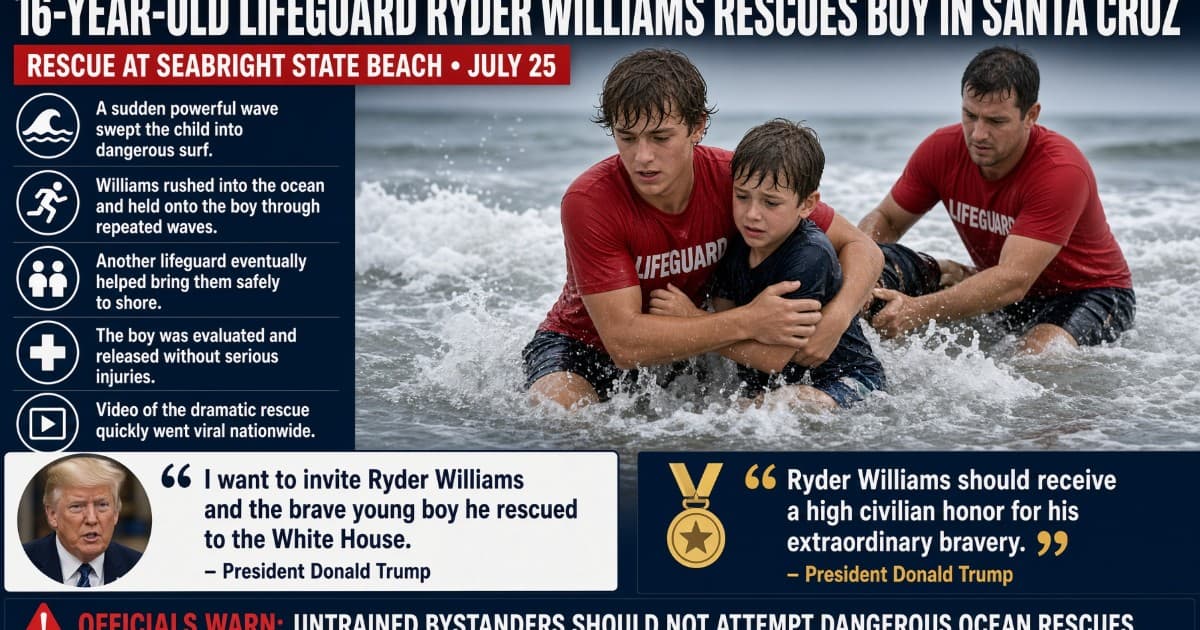
Teen Lifeguard, 16, Hailed as Hero After Dramatic Rescue of Boy From Massive California Waves
By The Daily Ledger8 min read21 views
A 16-year-old rookie lifeguard is being hailed as a hero after battling towering waves at a Santa Cruz beach to rescue a young boy swept into dangerous surf. Dramatic video of the rescue went viral nationwide and even drew praise from President Donald Trump, who said he wanted to honor the teenager at the White House.
Teen Lifeguard, 16, Hailed as Hero After Dramatic Rescue of Boy From Massive California Waves
A 16-year-old rookie lifeguard is being celebrated across the United States after dramatic video captured him battling powerful Pacific Ocean waves to save a young boy from potentially deadly surf at a California beach.
The rescue happened on July 25 at Seabright State Beach in Santa Cruz.
The teenage lifeguard, identified as Ryder Williams, was working his first summer as a California State Parks lifeguard when he noticed a child being swept into the ocean.
Within moments, Williams rushed toward the water.
What followed was a harrowing struggle against enormous breaking waves that repeatedly crashed over both the lifeguard and the boy.
Video captured by Santa Cruz resident Scott Vander Dussen shows Williams refusing to release the child even as the powerful surf repeatedly pushed them beneath the water.
The footage quickly went viral, drawing national attention and eventually reaching President Donald Trump.
A Routine Beach Day Suddenly Turns Dangerous
The dramatic incident began when powerful waves unexpectedly surged onto Seabright State Beach.
Williams later explained that he was near the waterline when he saw a child lose his footing in relatively shallow water.
The situation changed almost immediately.
The child was pulled away from shore by the powerful water.
Williams recognized the danger and reacted.
He radioed for assistance, left his equipment near his lifeguard tower and ran toward the boy.
The teenager then entered the turbulent ocean.
Lifeguard Battles Massive Waves
Reaching the child was only the beginning of the rescue.
The surf was exceptionally powerful.
Video shows enormous walls of whitewater crashing repeatedly over Williams and the boy.
At several moments, both disappear almost completely beneath the waves.
Williams later said the child had become limp during the rescue.
Despite the conditions, he maintained his grip.
The teenager positioned himself around the boy and attempted to keep him from being dragged farther out to sea.
Each new wave pushed them backward.
But Williams continued holding on.
Witnesses Watch the Rescue Unfold
Scott Vander Dussen, a Santa Cruz resident who captured the rescue on video, had been at the beach when the dangerous conditions developed.
He began recording after seeing the emergency unfold.
The resulting footage shows just how difficult the rescue became.
Several adults can be seen attempting to enter the water to assist.
But the surf was so powerful that some were quickly knocked backward or forced to retreat.
At one point, beachgoers attempted to form a human chain.
The waves repeatedly disrupted those efforts.
The scene demonstrated why professional water-rescue training was so important.
Another Lifeguard Joins the Rescue
Williams continued protecting the child while waiting for additional assistance.
Eventually another lifeguard, Aaron Bohnen, entered the water.
Together, the lifeguards were able to make progress toward shore.
After struggling through repeated waves, they successfully brought the boy out of the dangerous surf.
Medical personnel evaluated the child afterward.
According to California State Parks and subsequent reporting, the boy did not suffer serious injuries and was reunited with his parents.
A frightening incident that could have ended in tragedy instead became an extraordinary rescue.
The Video Goes Viral
Footage of the rescue quickly spread across social media.
Millions of viewers were able to watch Williams repeatedly disappear beneath powerful waves while refusing to let go of the child.
The teenager's composure attracted particular attention.
Experienced lifesaving officials who reviewed the footage praised his actions.
Rather than attempting to overpower every incoming wave, Williams appeared to work with the conditions while protecting the child's airway and preventing him from being carried farther offshore.
The combination of courage, training and calm decision-making helped turn the teenager into a national hero.
Trump Responds to the Rescue
The story eventually reached President Donald Trump.
Trump publicly praised the teenage lifeguard and said he wanted to invite Williams and the rescued child to the White House.
The president also said he wanted the teenager recognized with a high civilian honor.
Trump's response pushed the story beyond California and transformed the rescue into a national news event.
The president described the teenager's actions as extraordinary and said he deserved recognition for his bravery.
A 16-Year-Old Rookie Lifeguard
One of the most remarkable details is Williams' age.
He was only 16.
It was also his first summer working as a California State Parks lifeguard.
Despite his limited professional experience, Williams reacted with the discipline expected from a far more experienced rescuer.
He later described the incident modestly.
Williams said he was grateful that he had been able to return the child safely to his family.
He also emphasized that rescuing people is part of his job.
That response attracted additional praise.
While millions of people viewed him as a hero, Williams presented his actions as the responsibility he had accepted when becoming a lifeguard.
Dangerous Surf Hits Santa Cruz
The rescue occurred during unusually hazardous ocean conditions along the California coast.
Large swells and powerful shore break created dangerous conditions for swimmers.
Authorities warned about sneaker waves, strong currents and waves that could reach approximately 10 feet.
Santa Cruz lifeguards were extremely busy during the period.
California State Parks reported dozens of rescues across the Santa Cruz District over the weekend.
The incident involving Williams was therefore dramatic, but it was not the only emergency lifeguards encountered.
Why the Ocean Became So Dangerous
Ocean conditions can change much faster than many beach visitors realize.
A shoreline that appears manageable can suddenly experience much larger sets of waves.
Sneaker waves are particularly dangerous because they can travel significantly farther up a beach than surrounding waves.
People standing in apparently shallow water can suddenly lose their footing.
Once someone is pulled into powerful surf, returning to shore can become extremely difficult.
That appears to be what happened during the Santa Cruz rescue.
The boy reportedly lost his footing in shallow water before being pulled farther into the ocean.
Seconds later, he was in a potentially life-threatening situation.
Why Bystanders Should Be Careful
The video also contains an important safety lesson.
Several people attempted to help Williams during the rescue.
Their intentions were good.
But entering violent surf without professional training can create additional victims.
Some of the adults attempting to assist were knocked down or forced backward by the waves.
Water-safety experts generally advise people to alert trained lifeguards rather than entering dangerous surf themselves unless they have appropriate rescue training.
A drowning or distressed swimmer can also unintentionally place a rescuer in danger.
Williams had professional training specifically designed for this type of emergency.
Training Made the Difference
Experts who reviewed the footage praised the teenager's technique.
Williams remained focused on protecting the child while dealing with repeated waves.
Instead of panicking when the pair were submerged, he continued controlling the rescue.
That ability is developed through training.
Lifeguards learn how to read waves, currents and changing ocean conditions.
They also learn how to approach distressed swimmers and how to protect themselves while performing a rescue.
In this case, those skills were tested under extreme conditions.
From Local Rescue to National Recognition
What began as an emergency on a California beach quickly became a national story.
The rescue was filmed.
The video spread online.
News organizations picked it up.
Viewers across the country praised the teenager.
And eventually the president of the United States responded.
That sequence demonstrates how rapidly extraordinary acts captured on smartphones can reach national audiences.
Without Vander Dussen's camera, Williams might simply have finished the rescue and returned to his lifeguard tower.
Instead, millions of people witnessed what lifeguards sometimes face while protecting beachgoers.
Williams Returns to Work
Perhaps one of the most striking details came after the rescue was over.
Williams did not treat the incident like the end of his day.
After the child was safe, he returned to his lifeguard duties.
The teenager has repeatedly emphasized that he views what happened as part of the job he was trained to perform.
That humility has become another reason people have praised him.
For Williams, however, the most important outcome was simple:
The child went home safely.
A Powerful Reminder About Lifeguards
The viral video has also brought renewed attention to the work performed by open-water lifeguards.
Beach rescues can be very different from rescues in swimming pools.
Ocean lifeguards must deal with waves, currents, changing tides, limited visibility and unpredictable conditions.
They may have only seconds to make decisions.
A mistake can endanger both the victim and the rescuer.
The Santa Cruz footage provides a rare close look at those challenges.
Bottom Line
Sixteen-year-old Ryder Williams was working his first summer as a California State Parks lifeguard when a young boy was suddenly swept into dangerous surf at Seabright State Beach.
Williams reacted immediately.
He entered the ocean, reached the child and refused to let go while powerful waves repeatedly crashed over them.
Another lifeguard eventually joined the rescue, and together they brought the boy safely back to shore.
The child was evaluated and released without serious injuries.
Video of the rescue went viral across the country, earning Williams widespread praise and attracting the attention of President Donald Trump.
Trump said he wanted to invite Williams and the rescued boy to the White House and honor the teenage lifeguard for his bravery.
For millions who watched the footage, Williams became a hero.
For the 16-year-old lifeguard himself, it was much simpler.
He saw someone who needed help, relied on his training and did his job.
And because he did, a child returned safely to his family.
#Climate
Related Stories
Breaking News

Comments (0)
No comments yet. Be the first to share your thoughts.
Leave a comment
Comments are reviewed before they appear.