 Breaking News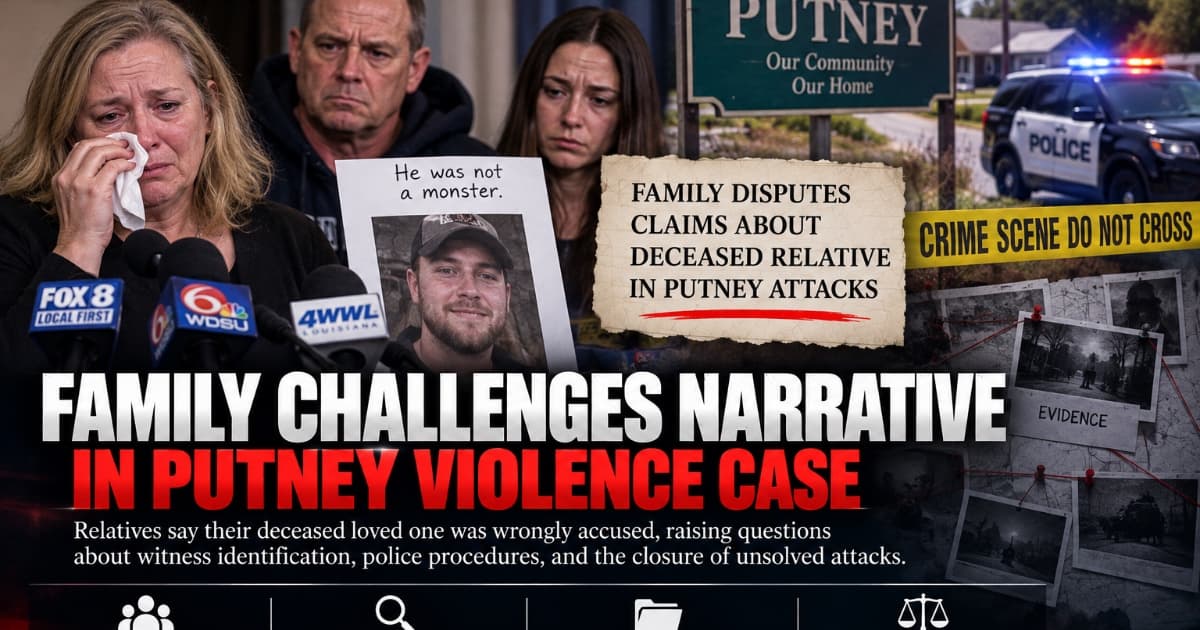
Breaking News
Family Questions Whether Deceased Relative Was Putney Attacker
By The Daily Ledger2 min read12 views
A family is challenging the assumption that their deceased relative was responsible for a series of violent attacks in Putney, raising fresh questions about a…
A family has come forward to challenge longstanding assumptions about their deceased relative's involvement in a series of violent incidents in Putney, reopening questions about a case many believed to be settled.
The pushback centers on whether the individual was accurately identified as responsible for attacks that alarmed residents and prompted police investigation. The family argues that the connection was made without sufficient evidence or that details have been misrepresented over time.
Cases involving deceased suspects present particular investigative challenges. Once a person dies, criminal prosecution becomes impossible, and police investigations often conclude on the assumption that the matter has been resolved. However, such closure can sometimes occur before all evidence has been rigorously tested or alternative suspects fully eliminated.
The identification of suspects in assault cases frequently relies heavily on witness testimony, which can be subject to memory degradation, misidentification, or other factors affecting accuracy. When multiple incidents occur in the same area over time, pressure to resolve the cases can accelerate the attribution to a single individual, particularly if that person has already come under suspicion.
The family's challenge raises broader questions about investigative practices and the mechanisms available for revisiting conclusions once a suspect has died. In some jurisdictions, formal cold case review processes exist to re-examine cases where new evidence emerges or where questions linger about the original investigation's thoroughness.
Authorities' response to the family's claims will likely determine whether the case receives fresh examination or whether it remains officially closed. Public confidence in criminal investigation depends partly on the willingness to reconsider conclusions when credible doubts are raised, even years or decades after incidents occur.
The case also highlights the human cost of criminal investigation—not only for victims of violence, but also for families of those accused, whose reputations and legacies can be shaped by investigative decisions made under pressure or with incomplete information.



Comments (0)
No comments yet. Be the first to share your thoughts.
Leave a comment
Comments are reviewed before they appear.