 Breaking News
Breaking News
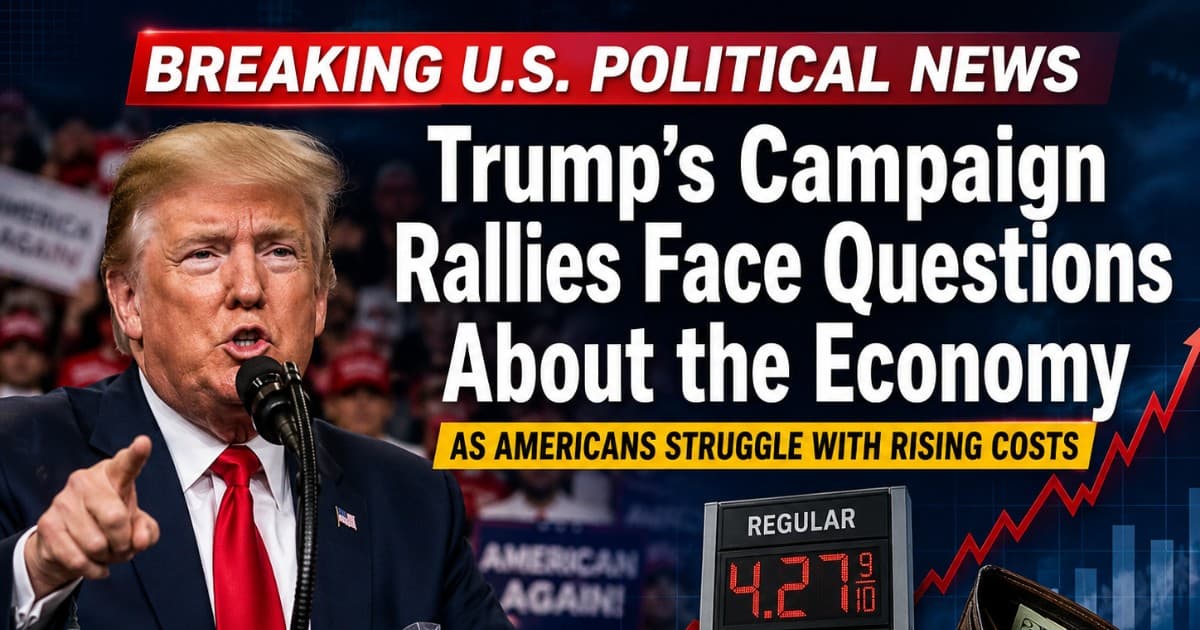
BREAKING U.S. POLITICAL NEWS: Trump’s Campaign Rallies Face Questions About the Economy as Americans Struggle With Rising Costs
By The Daily Ledger6 min read560 views
TRUMP'S ECONOMIC PROMISES UNDER FIRE: Rising Costs Spark Tough Questions at Campaign Rallies!
WASHINGTON, D.C. — President Donald Trump's nationwide campaign rallies are drawing increased scrutiny as he attempts to convince American voters that his economic policies are delivering prosperity, even as millions of households continue to struggle with rising living costs, expensive gasoline, and financial uncertainty.
With the November 3, 2026, midterm elections approaching, Trump is traveling across the United States to strengthen Republican support and protect his party's position in Congress.
However, a central question is emerging from his campaign appearances: If the American economy is performing as strongly as the president claims, why are so many voters still struggling to afford everyday necessities?
Reuters reported on October 24 that Trump's campaign speeches have emphasized economic accomplishments, strong financial markets, and low unemployment. Yet the message is colliding with public frustration over inflation and household expenses.
Reuters +1
- Trump's Economic Message Faces Growing Skepticism At recent rallies, Trump has defended his administration's economic performance, highlighting positive indicators such as employment, stock market gains, and measures of economic growth.
The president argues that his policies are strengthening American industry, attracting investment, and creating opportunities for workers.
But economic statistics do not always reflect the financial experiences of ordinary Americans.
Many families are dealing with expensive groceries, transportation, housing, and borrowing costs. While some economic indicators remain positive, household budgets continue to face pressure.
According to an Associated Press economic assessment published October 21, annual consumer price inflation reached 3.7%, while economic growth averaged slightly above 2% under Trump's second administration.
The figures indicate that the U.S. economy is continuing to expand, but inflation remains a significant challenge.
The Associated Press +1
- Gasoline Prices Become a Major Political Problem One of the biggest challenges facing Trump's economic message is the cost of gasoline. Average U.S. gasoline price $4.27 Per gallon, Reuters October 24
Year-over-year increase ~40% National gasoline average
Reuters reported that gasoline prices were nearly 40% higher than a year earlier, according to AAA data.
The ongoing war involving Iran has contributed to disruptions in energy markets, increasing pressure on fuel prices. Trump has repeatedly suggested that gasoline prices will decline once the conflict ends.
For Americans who depend on their vehicles for work, transportation, or farming, the increase represents a significant financial burden.
Higher fuel costs can also raise the price of transporting food and consumer goods, adding pressure throughout the economy.
Sports Radio KWSN +1
- Farmers Express Frustration at Republican Campaign Events Trump's October 19 campaign rally in Park City, Kansas, highlighted the economic difficulties facing American agricultural communities.
Farmers have been struggling with rising diesel, fertilizer, and equipment costs, alongside trade uncertainty and reduced profit margins.
According to the Associated Press, diesel prices reached approximately $6.30 per gallon nationwide during the period, more than 70% higher than a year earlier.
The U.S. Department of Agriculture projected a 2.6% decline in net farm income for 2026, with production expenses rising 4.5%.
Trump responded by announcing an $8 billion harvest fuel relief program intended to support farmers dealing with increased energy costs and market disruptions.
Although the assistance could provide relief, some agricultural producers remain concerned that temporary financial support will not solve broader problems involving export markets, tariffs, and production expenses.
AP News +2
- Public Opinion Polls Show Economic Disapproval A recent Associated Press-NORC survey revealed substantial dissatisfaction with Trump's handling of economic issues. Americans' views of Trump's economic performance
AP-NORC survey, September 24–28, 2026; 2,140 U.S. adults
0%25%50%75%100%Approve: cost of li…Approve: overall ec…Blame Trump policie…
Source: AP-NORC. Figures refer to different survey questions.
The survey found that only 17% of American adults approved of Trump's handling of the cost of living, while 26% approved of his management of the overall economy.
Meanwhile, 65% said his policies were more responsible for persistently high prices than factors outside his control.
These findings indicate that economic dissatisfaction extends beyond Democratic voters and presents a political challenge for Republicans heading into the midterms.
The poll's overall margin of sampling error was plus or minus 2.9 percentage points.
AP News
- Republicans Face Unexpected Challenges in Traditionally Conservative States Trump's campaign schedule also reflects Republican concerns about competitive elections in states that have historically favored the party.
Kansas, Iowa, Nebraska, and Ohio have become important battlegrounds as economic dissatisfaction threatens Republican voter enthusiasm.
In Kansas, Republican Senator Roger Marshall faces a challenge from Democrat Adam Hamilton. In Iowa, Republicans are defending competitive races for governor and the U.S. Senate.
Republican strategists are concerned that frustrated supporters may decide not to vote, even if they remain loyal to Trump.
Democrats, meanwhile, are attempting to make affordability, tariffs, and economic management central issues in their campaigns.
However, voter dissatisfaction does not automatically translate into Democratic victories. Some Republican supporters continue to believe Trump's policies will deliver longer-term economic improvements.
The Washington Post +2
- Trump's Rally Speeches Raise Questions About Campaign Strategy Beyond economic policy, Trump's rally appearances have attracted attention for their wide-ranging subjects.
Reuters reported that his speeches have included attacks on political opponents, discussions of crowd sizes, comments about international conflicts, and personal observations about other politicians.
His supporters often appreciate this unconventional speaking style, viewing it as a defining characteristic of his political identity.
Critics argue that lengthy diversions can distract from issues such as inflation, wages, housing affordability, and the cost of living.
The challenge for Trump is to energize his political base while convincing economically dissatisfied voters that Republicans have credible solutions to their financial concerns.
Reuters +1
- What Could Happen in the November 3 Midterm Elections? The upcoming congressional elections will help determine whether Republicans retain control of Congress or Democrats gain enough seats to challenge Trump's legislative agenda.
Economic concerns could influence turnout and voting decisions, especially among independents, working-class households, rural communities, and voters facing financial pressure.
If Republicans perform poorly, the results could complicate Trump's ability to advance his domestic policy priorities. Strong Republican results, by contrast, could reinforce his political influence.
The outcome remains uncertain. Voters will weigh economic conditions alongside immigration, national security, foreign policy, and other issues. 8. What This Means for the American Economy The central economic debate is not simply whether the U.S. economy is growing. It is whether that growth is improving Americans' daily lives.
A rising stock market, expanding GDP, and relatively strong employment conditions can coexist with financial hardship for households.
Trump and his allies emphasize economic expansion, investment, and measures intended to support American businesses and workers.
His opponents emphasize rising consumer prices, the costs associated with tariffs, and the economic consequences of the Iran conflict.
Both the administration's policy choices and external developments will influence whether inflation moderates and household affordability improves. News Excerpt — Original Summary President Donald Trump's campaign rallies are facing mounting economic scrutiny as Americans struggle with rising gasoline prices, persistent inflation, and the high cost of everyday necessities. With the November 3 midterm elections approaching, Trump is promoting economic growth, employment, and stock market performance while seeking to energize Republican voters across the country. But recent polling shows widespread dissatisfaction with his handling of affordability, creating political challenges even in traditionally conservative states. As Republicans fight to retain congressional control, the question remains whether Trump's promises of economic prosperity will resonate with voters whose household budgets are still under pressure.
##DonaldTrump #TrumpNews #BreakingNews #HotNews #USA #AmericanNews #5000Dollars #StimulusCheck #GovernmentNews #USNews #LatestNews #TrumpAnnouncement #AmericanCitizens #FinancialUpdate #NewsToday##BreakingNews #TrumpAdministration #AlaskaSenate #USPolitics #Election2026 #DonaldTrump #MaryPeltola #DanSullivan #JusticeDepartment #MidtermElections #AmericanNews


Comments (0)
No comments yet. Be the first to share your thoughts.
Leave a comment
Comments are reviewed before they appear.