 Breaking News
Breaking News
BREAKING🚨: Trump Administration Sues to Block Alaska Senate Election Results if Republican Loses!
By The Daily Ledger7 min read112 views
Trump Administration Sues Over Alaska Senate Election — Seeks to Block Certification if Republican Loses
🚨 BREAKING NEWS: TRUMP ADMINISTRATION SUES TO BLOCK ALASKA SENATE ELECTION CERTIFICATION IF REPUBLICAN LOSES
WASHINGTON, D.C. — October 23, 2026
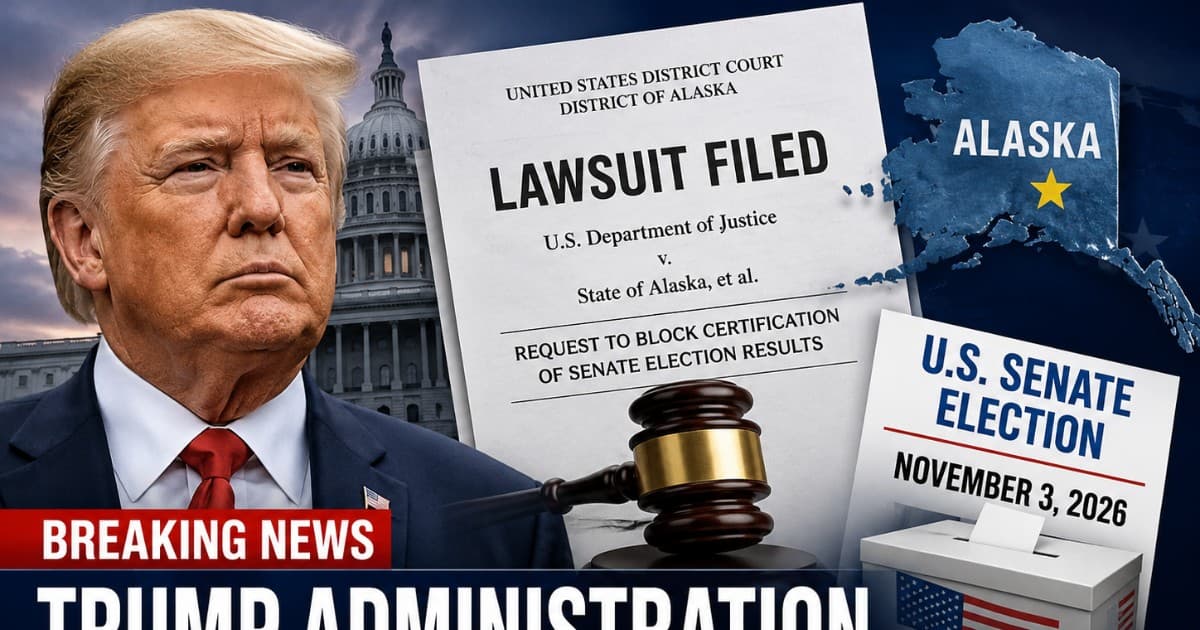
A major political and legal confrontation is unfolding in the United States after President Donald Trump's Justice Department filed a federal lawsuit seeking to prevent Alaska from certifying certain U.S. Senate election results if Republican incumbent Senator Dan S. Sullivan loses his reelection bid.
The lawsuit, filed on October 22 in federal court in Anchorage, comes less than two weeks before the November 3 midterm elections. At the center of the dispute is an unusual situation involving two Senate candidates with nearly identical names.
The case is drawing national attention because the Alaska Senate race could help determine which political party controls the United States Senate.
THE CONTROVERSY: TWO CANDIDATES NAMED DAN SULLIVAN
Republican Senator Dan S. Sullivan is seeking another term in office against Democratic challenger Mary Peltola, a former U.S. representative.
However, another candidate, Daniel J. Sullivan, is also running in the election.
Daniel J. Sullivan, a retired teacher and former U.S. Forest Service worker from Petersburg, Alaska, registered as a Republican before entering the race.
Republican officials have accused him of deliberately attempting to confuse voters and draw support away from the incumbent senator.
The Justice Department alleges that some voters intending to support Senator Dan S. Sullivan might accidentally vote for Daniel J. Sullivan instead.
If enough voters make that mistake, federal officials argue, the confusion could potentially change the election's outcome.
Daniel J. Sullivan has denied the allegations, maintaining that he entered the race independently because he wanted different political representation for Alaska.
No court has established that he is secretly working for Democrats or intentionally misleading voters.
WHAT EXACTLY IS THE JUSTICE DEPARTMENT DEMANDING?
The federal lawsuit does not seek to cancel the entire election before voting begins.
Instead, the Justice Department wants a federal judge to prevent Alaska from certifying a result under specific circumstances.
Those circumstances would arise if Senator Dan S. Sullivan loses but would have won had votes cast for Daniel J. Sullivan instead gone to the incumbent, after accounting for Alaska's ranked-choice voting process.
The government is requesting an investigation into whether some voters selected the wrong Sullivan.
Federal officials argue that certifying an election affected by such confusion could violate the National Voter Registration Act.
The lawsuit is an allegation and request for judicial relief, not a finding that election fraud has occurred.
ALASKA SUPREME COURT ALREADY RULED ON THE CANDIDATE
The dispute began before the federal lawsuit.
Alaska election officials previously attempted to remove Daniel J. Sullivan from the ballot, arguing that his candidacy could mislead voters.
However, the Alaska Supreme Court ruled that he could remain a candidate.
The state's election authorities subsequently distinguished the two candidates on the ballot.
Senator Dan S. Sullivan is identified as the Republican incumbent, while Daniel J. Sullivan appears without a party designation.
Despite that earlier state court ruling, the Trump administration is now pursuing a separate federal legal challenge involving certification of the election results.
WHY ALASKA'S RANKED-CHOICE VOTING SYSTEM MATTERS
Alaska uses ranked-choice voting in its general elections.
Rather than selecting only one candidate, voters can rank candidates according to their preferences.
If no candidate wins a majority of first-choice votes, the lowest-ranked candidate is eliminated and votes are redistributed according to voters' next available preferences.
This process continues until a candidate receives a majority of the remaining votes.
Supporters of ranked-choice voting argue that the system gives voters more flexibility and can reduce the impact of vote splitting.
However, the Justice Department contends that confusion between the two Sullivan candidates could still affect how voters rank their choices.
Determining whether a voter intentionally supported one candidate or mistakenly selected another could prove particularly difficult because ballots are secret.
TRUMP'S RESPONSE TO THE ELECTION CONTROVERSY
President Donald Trump has publicly criticized Daniel J. Sullivan's candidacy.
During an Alaska campaign appearance and in social media posts, Trump accused the second Sullivan of attempting to interfere with the election.
The president also indicated that his administration was considering legal action.
Republican supporters of the incumbent argue that voters should not be misled by candidates with nearly identical names.
Critics of the administration, meanwhile, say the lawsuit risks allowing the federal government to challenge legitimate election results based on speculation about voter intentions.
The Justice Department maintains that its objective is to protect election integrity.
DEMOCRATS AND LEGAL EXPERTS QUESTION THE LAWSUIT
Democrats have criticized the administration's attempt to intervene in the election certification process.
They argue that the state should count legally cast ballots and certify the winner according to Alaska election law.
Some election-law experts have also expressed serious doubts about the Justice Department's legal argument.
Notre Dame law professor Derek Muller has questioned whether the National Voter Registration Act gives the federal government authority to prevent certification under the circumstances described in the lawsuit.
The legal dispute raises a broader constitutional question about the balance of power between federal authorities and states, which ordinarily administer elections.
The federal court will ultimately determine whether the Justice Department has established a valid legal basis for its requested intervention.
WHY THE SENATE RACE IS SO IMPORTANT
The Alaska election is attracting national attention because Republican Senator Dan Sullivan and Democrat Mary Peltola are competing in a closely watched contest.
Polling reported before Election Day has shown Peltola tied with or slightly ahead of the incumbent in some surveys.
Alaska has traditionally favored Republicans in presidential elections, but its voters have also supported candidates from different political parties in statewide races.
A Democratic victory in Alaska could contribute to a broader shift in the balance of power in Washington.
That could affect which party controls Senate committees, advances legislation, and oversees presidential appointments.
However, the final national balance of power will depend on the results of multiple Senate elections, not Alaska alone.
WHAT HAPPENS NEXT?
The case has been assigned to U.S. District Judge Sharon Gleason.
Several possible developments could follow:
-
The lawsuit is dismissed: The federal court could determine that the Justice Department lacks sufficient legal grounds to block certification.
-
The court considers further proceedings: A judge could examine the government's arguments and the state's response before deciding whether any relief is justified.
-
The election result makes the dispute irrelevant: If Senator Sullivan wins, or if the vote totals do not satisfy the government's proposed conditions, the requested intervention may no longer be necessary.
-
A certification dispute develops: If the election produces a result covered by the lawsuit and the court grants relief, Alaska could face a legal dispute over formally confirming the winner.
Any interruption to certification could potentially delay the seating of Alaska's next senator.
THE BIGGER NATIONAL QUESTION
The Alaska lawsuit has become more than a dispute over two candidates sharing a name.
It is also raising questions about federal involvement in state elections, the legal standards for challenging results, and how election officials should respond to claims of voter confusion.
Supporters of the Justice Department's position say protecting voters from misleading ballot circumstances is essential.
Opponents argue that courts should not invalidate or delay legitimate results without convincing evidence and clear legal authority.
For now, the election has not taken place, no winner has been declared, and no court has ruled that votes should be reassigned from one candidate to another.
As November 3 approaches, Alaska voters, political leaders, and election-law experts will be watching closely to see whether the federal lawsuit changes the certification process — or whether the state's election proceeds to a normal conclusion.
The central question remains: Can the federal government stop certification based on the possibility that voters confused two candidates with similar names?
**The News Service reporting published October 23, 2026.
##BreakingNews #TrumpAdministration #AlaskaSenate #USPolitics #Election2026 #DonaldTrump #MaryPeltola #DanSullivan #JusticeDepartment #MidtermElections #AmericanNews


Comments (0)
No comments yet. Be the first to share your thoughts.
Leave a comment
Comments are reviewed before they appear.